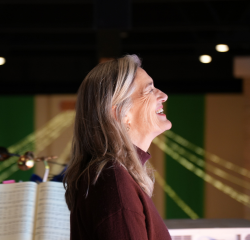
After the group session I walked down to the Oyak, the Taize cafe that opens three times a day for a half an hour or so. The Brothers had come up with the idea for the small concession stand— where everything is sold at cost— to prevent vending trucks from coming into the village and taking advantage of the young people by selling them snacks at jacked-up prices. It was hot and I wanted a cool beverage and although I’ve never ordered an Orangina in my life (the name’s just too funny) in that warm afternoon, when my throat was dry, it was the most refreshing thing I’d every had. Cost: 40 cents US. I leaned up against a cafe table and began to pull at the threads of a recurring thought. “Can something be considered evil if the person doing it doesn’t know any better?” It was a question Rasmus had asked in our group— the only time he’d broken off from his duties as Michael’s translator (Opting for Joy, 1 & 2) to pose his own question. We had been discussing the idea of distinguishing between a person and the offense.
The argument toggled back and forth— both in the group and now in my own metronomic mind— between “is it really possible that they don’t know?” “Is not His word planted within each of our hearts?” “Do we not choose the path of light or dark?” and then the matters that spill from theology into the areas of child development… But What About…”children who are raised in extremist conditions? Who are taught only hate, war, darkness, violence? Do they really know? Can they know?” and then another outgrowth to consider “Are we viewing evil as being equal to sin, or is it an extreme, chronic and unrepentant form of sin?” “And if sin is the equal of evil, and if we are all born sinful, are we all not, also, evil, whether we recognize it or not?” But, But— Around and around I went, sipping my Orangina, snacking on a bag of Fair Trade paprika-flavored Yucca Chips.
I had learned a new term in a Bible study that spring. Curvatus in se. It was first used by St. Augustine to describe sin as “man turned in on himself.” It was the most revelatory description I’d ever heard and had helped me immensely in my understanding of sin. But still I wrestled with the idea of Original Sin, and the notion of children being sinful by nature when so much of their self-centered behavior is simply age appropriate and essential to growth at different stages. But, but— I was just about to flip this idea over on its head again when a man approached.
“May I join you?” We exchanged quick pleasantries, introductions —he was visiting from Germany, probably a little older than me— but then we both fell back into parallel silences filled with our own thoughts.
“You look like you have a lot on your mind,” I said, calling myself into the moment.
“Yes,” he said, “I have come with two serious problems to consider.”
Phew, I thought. So it wasn’t just me sitting here in the sunshine in the Burgundy hillside arm-wrestling with Original Sin. This oughta be good. “What are the two problems?” I asked.
“Well, my sister and I had a quarrel before I left and I’m thinking I’ll have to mend things when I get back.”
“Oh,” I said, somewhat disappointed by the scope of his concern. “And the other one?”
“My son has just finished his studies and now he needs to find a job and I’m wondering what I should do to help.”
“How old is your son?” I asked.
“Twenty-eight.”
I buried my smile in my Orangina before responding. Some answers are solved by theology and some by child development. “Don’t do anything,” I told him. “Your son is a grown man.”
“I know,” he said, sheepishly. “But-”
“He’s going to have to figure it out for himself.”
“But-”
There are answers we don’t want to hear, but have to. Hard truths at the Oyak cafe.
 Heather Choate Davis