By Saturday morning we had to dodge vans and throngs on the way to the Church for morning prayers. I entered through the far back side, grateful to even find a spot in the main sanctuary. Those arriving later would end up one— or even two— large rooms back, connected to the whole by the music and intermittent icons, but still, a bit removed. I sat on a step off to the side craning for a view of the altar. I watched as the Brothers glided in, took their spots. This was the first time I would see the deep center of the sanctuary, where the readers were, where the young brothers sat discreetly behind Brother Alois as a safety measure.
Alois, who was confirmed as a Roman-Catholic, had arrived in Taize in his late teens and, essentially, never left. Brother Roger, a Swiss Reform Protestant, had mentored him throughout his life. By the time he had reached his mid-thirties, it was quietly understood that he would become the spiritual leader of the community whenever Roger passed. No one had anticipated a death like Brother Roger’s. One night during evening prayers, a deranged Romanian woman suddenly leapt over the low hedges and stabbed him to death. Most in the church had no idea what was happening. One of the brothers rose and urged everyone to continue praying; several of the brothers attempted to offer aid on the site. By the end of the service, a member of the community stood up and announced that Brother Roger was dead. The next morning, the prayers went on as scheduled, with Br. Alois now sitting in the head position, which has since been moved to the center of the church.
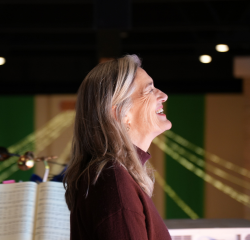
I now looked up and realized I had a perfect view of Br. Alois in profile, seated on his kneeler, as if he were in the center of a cross and I was an extension of one of the arms. No head obstructed my eyeline. No movement distracted me. For a moment he was a living, breathing icon. I will tell you quite foolishly that he is an extraordinarily handsome man, with classic French features. It was easy to picture him in a cashmere v-neck and Italian shoes and an expensive watch, sipping Beaujoulais, entertaining friends onto his yacht. But he was here, and had been his entire adult life. It is often said of certain very holy people that they glow. It may even sometimes be true. In the case of Br. Alois, I can tell you with full assurance that I have never seen such a quality of peace and light— such golden light— radiating off a human being anywhere. Ever. Just to know that a man like this exists on this earth is all the proof of Christ I, or anyone, would ever need.
After the prayers and the breakfast (for which the queue now snaked down the road), we gathered for the last time with Br. John to discuss our theme, the Name of God, which he told us in summary, was not a name but a person. Jesus Christ. He also returned to a point that had woven throughout the week, and left us with this thought:
Love transforms anger into suffering.
That may, at first, not seem like such a bargain, but consider this: suffering can be carried. Suffering can be moved beyond. Christ comes to us and offers love, neutralizes anger, darkness, evil, despair, carries them, transforms them, absorbs them, until bit by bit, they are reconfigured into joy.
This is how Br. Alois and Br. John and all the angels and saints get up in the morning in a world full of evil, violence, madness, and despair, and move through the day in the full confidence of the promises of God. This is how we may do the same. 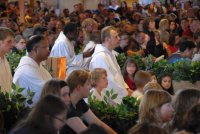
 Heather Choate Davis