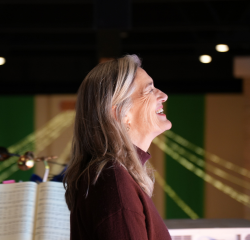
With no discussion or plan, each of us — me, Alistair, Michael, Rasmus, and Hele— ended up down at the Oyak in the late afternoon where, for pennies a serving, you could enjoy a three ounce paper cup of wine. Just one. “But we’re adults,” I said to the young man behind the counter. “We’re not going to go crazy, I promise.” “I’m sorry,” he said. “But we must have the same rules for everyone.” This was a recurring theme at Taize, a cornerstone of justice, a hard one for me to grasp, evidently. And so we took our little cups and found a table to lean up against and continued our group in a more personal and convivial fashion.
Alistair began to tell a story about taking communion that morning. Unbeknownst to me, the Brothers actually offered a semi-private, segregated communion in a small chapel space behind the main church before morning prayers. I imagined this was for people who felt so strongly about the sanctity of their own Eucharist that, for them, it would be a violation to even commune in the same building with those of another tradition. There was a separate door for Catholics and Protestants. Alistair was an Anglican. He had arrived a bit late but, upon entering the space, heard the familiar liturgy, and felt certain he was with “his” people. It was not until he’d taken the bread and the wine and exited prayerfully that he realized he’d been with the Catholics all along.
“Oh my,” I teased. “God really got the last laugh on that one, didn’t he?”
“Well, I haven’t been struck dead yet,” he said, and for the first time since I’d met him he actually seemed to relax and smile.
We continued to share about our homes, our families, our own churches. Hele asked about me, about my involvement at church back in the states. “You seem to know a lot,” she said in broken English.
“Well, I’ve been pretty involved with a lot of things,” I said. “Right now, I’m actually the President of our congregation.”
If wine hadn’t been so hard to come by, Alistair’s small sip might have shot clear out of his mouth. “What does that mean?”
I turned to him playfully. “Is there something ambiguous in the title, Alistair?”
“Well, I mean, is that some form of lay leadership?”
“Well, I work to support the pastor and oversee all the church boards and head up the council, so yes, I guess you could call it that.”
I’m not sure if the word that came out of his mouth was an actual term or merely a primal groan but it was in the family of “bollocks,” uttered with a violent shake of the head and a flapping of the cheek. Across the table, Michael let loose his own brand of atavistic howl. “See,” Alistair said, “Michael knows what I’m talking about. Women do not belong in leadership in the church in any capacity, certainly not in high authority.”
“It’s not a big political statement or anything, Alistair. I was just the right person at a certain moment in time. That’s all,” I said, and turned to Michael to clarify. “Michael, you don’t really have a problem with that, do you?”
Rasmus laughed and assured me that he did not (what he was howling about, I’ll never know). But in that warm and friendly late afternoon I realized in a way that I had not before, that strong differences of opinion are merely a fact of life, and the only hope for any softening of the hard edges, any movement towards common ground, was to see and know and try to understand the Other. Let us drink to that.
 Heather Choate Davis