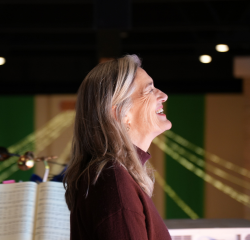
One thing I’ve noticed—and I’m noticing it a lot lately—whenever I’m in a totally unlikely place where there seems to be no rhyme or reason to me being there, I’m right where God wants me. This morning it meant spending several hours with an Ethiopian Orthodox congregation celebrating their world-wide church anniversary. I was invited there by Father Mussie Behre, the head of the church, and a man with whom I developed a close friendship during my theology studies. Curiously, he was getting his MA from Concordia, a Lutheran university. Many years ago, when he had been tasked with planting a new Ethiopian Orthodox church in L.A., he’d gone to all the traditional black mega-churches to ask if he might rent out space for their “start-up.” In his church they worship on Saturday, so there is no conflict, but still none of them would accommodate “outsiders” in their sanctuary. He asked if he might use one of the meeting rooms and again he was told No. Fr. Mussie then went to the smaller “black” churches all over L.A. and they, too, refused. Finally he went to a little Lutheran church—a predominantly white denomination, to be sure—and they said Welcome.
It was through that experience that he came to know and love the teachings of Martin Luther, participating at Concordia University in many U.S./Ethiopian ministry efforts, and finally coming to be a student there. We began our studies on the same day. When I saw him sitting alone at a table with a yellow pad, a pen, and his Bible—no laptop, no textbook—I could not help but come alongside him. As it would happen, he lived 15 minutes from me and he asked if I might give him a ride to class. I didn’t realize at the time that he meant every night for the next two years— no matter. Our commute was one of the great blessings of my life, with a richness of conversation that changed my views on just about every ordinary problem of the day.
When he called me this week to invite me to his church’s annual celebration I knew that this would be the time to finally experience our shared faith through his worldview.
“What time does it start?”
“Well, we will start at 4:30 a.m. and go til about 12:30. But you can come whenever you like. Stay however long you like. And please bring a friend, Heather,” he said. “So you will not feel so much in the minority.”
I ended up going alone. It was nearly 80 degrees by the time I left the house. I tried to make clothing choices that wouldn’t make me stand out too much but, really, who was I kidding. Flipping though mental postcards of African culture I imagined the dress would be bright and casual, but just in case—in case it was formal, in case women wouldn’t be allowed inside with bare arms—I grabbed a sweater. Good thing.
There were bodies spilling out the door as I attempted to enter, all of them, the men and the women, draped in full-length white-gauzy cape-like wraps. A gentleman—was he an usher?—came up to me and, with a face void of judgment, looked at the sweater spilling out of my purse and said, “Let’s put that on first.” The hallway floor was piled high on either side with shoes. I slipped mine off and held them as we walked together inside, me in my Land’s End sundress with a bright orange sweater, and the entire church draped in white and singing and praying in what I’m going to guess was Ethiopian. Needless to say this is not a language I speak but I welcomed the chance to just let their voices and prayers spill over me. The usher led me all the way up to the front where an entire row had been saved for me and any friends I might have brought along.
The funny thing is, I didn’t feel strange at all. I felt the carpet beneath my bare feet and thought yes, of course. Just as God has instructed Moses in Exodus (3:5) we are to take off our shoes because the ground that He meets us on is holy. I laughed to think how easily modern urban dwellers have adopted the habit of taking off shoes in the house to protect the carpet but we’ve forgotten all about the notion of the sanctuary as sacred ground.
The church was “dressed” in the garments of their Orthodox style, red satin draped over all the altar rails, and cascading down over make-shift mantles upon which rested giant framed Icons. 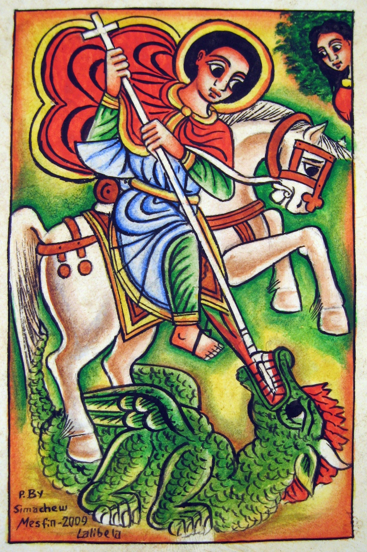 The practice of praying with Icons was essential in the early church but, sadly, was not maintained in the Western tradition. These visual “focal points” are a natural accompaniment to a service where songs are sung and prayers offered continuously for hours. I closed my eyes just to listen. When I opened them, everyone was kneeling. I dropped to my knees but felt no concern about “missing a beat.” The people seemed both happy and utterly unconcerned about me being there. They certainly had no expectation that I would know their tradition.
So what is the Ethiopian Orthodox tradition? Well, it is actually about as ancient and authentic of a Christian worship experience as one could have. Most Americans have no idea that Christianity has been the official religion of Ethiopia since the 4th century. They have a strong monastic tradition, and maintain many Judaic practices, including circumcision (for religious, not health reasons), a Saturday Sabbath, and the keeping of an Ark of the Covenant.” There are some doctrinal differences between the Orthodox and Roman Catholic and Protestant traditions, but none that should keep a follower of Jesus from praising God alongside them. “For all the apparent quirks of the Ethiopian church, only a daring outsider would venture to suggest that the faith for which Ethiopians have struggled and died for more than seventeen hundred years is anything less than a pure manifestation of the Christian tradition.” (Philip Jenkins, The Next Christendom).
Which brings me back to the Ethiopian Church in America in the year 2014, and to one particular church at the foot of Baldwin Hills, where soon the aspect of the exotic had faded and I was struck by just how much this was like any church in America. A woman beside me struggled to keep her kindergartener occupied with a coloring book for over an hour before finally deciding to take him out. A man across the aisle was dozing off. A woman on the other side of me knelt down for prayer—or so I thought— but was soon attempting to whisper into her purse. Periodically a ringtone went off in the sanctuary. A young boy circled with a recycling tub collecting the empty water bottles people had needed to sustain them in song and praise for so long.
The little ones were brought to the altar under a red silk umbrella where they were baptized and given communion, a sip of wine on a spoon from the great common cup. Communing infants is one of those differences in church practice that keeps theologians plenty busy but, to me, it just seemed a natural extension of a family/community oriented culture. All are part of God’s family from the littlest to the eldest.
And then Fr. Mussie stood before the red draped pulpit to greet everyone. I had been there an hour and a half already and had yet to hear a single word in English. Until then. “I would like to welcome today my dear friend, Heather Davis, who I met during my studies three years ago. She is a great helper to all people. She is ‘addicted to helping’ and we are so grateful to have her today, and want her to know that she—and all— are welcome every Saturday to praise God with us.” And then the whole congregation cheered and I knew—once again—how great and wide is the Body of Christ on Earth.
Another leader got up to begin what I imagine was the sermon. Somehow I could follow, by his inflections, the rhythm and cycle of life. Of repentance and forgiveness. Of grace and of hope. And then there would be peals of laughter and I would laugh too, just knowing that it was funny, and we were there, and I’m human, and God loves us all. And whatever he said, it was making all of us very happy.
I decided I would leave at the end of the sermon, then found myself wondering just how long a sermon during an 8-hour service might last. I picked up my shoes and my purse to be ready. The woman beside me said, “You must have food before you go. It’s already been blessed.”
“Oh,” I nodded. “Ok.”
She slipped out with me to the kitchen where a few dozen people were gathered, making preparations, chatting, not a frantic movement in the room. I was introduced to Ephraim who got me a take-out container fully prepared. “Sit,” he said, “I’ll get you water.”
He showed me how to tear the crepe-like bread that encased the spicy meat and sweet vegetables and I sampled several bites. A table of ladies waited for my approval. “Delicious,” I said.
As I left I thought about how American potlucks are all about our right to choose what we like but here that is not the point. Why take time being picky about food? Here, take, eat, enjoy what you’ve been given with friends—and linger. The meal after is much a part of the service as the worship itself. It is where the meal of communion is made manifest in the community that binds their lives. It is now that I began to feel like a stranger. Alone. Different. Other. One foot already out the door, racing back to my own L.A. life.
But I take with me many lessons from this brief visit. Be reverent. Be joyful. There is no need to rush. Be present. Eat. Enjoy. It is a beautiful day in L.A. And our God is very good indeed. If I come back enough times I may actually learn them. Until then…
Blessings to you Fr. Mussie. And to your beautiful congregation, Happy Anniversary!
 Heather Choate Davis