Clean at last

One might think that time spent in a monastic community anchored in ethereal chant music might pass in a dream state, floating effortlessly from one inspired moment to another. Someone else might have had that experience but for me Taize was a constant string of strategic and tactical decisions designed to maximize one-of-a-kind learning, prayer, and songtime, balance rest and caffeine-jolted wakefulness, and manage basic human needs— hygiene being one of them. Thursday night would be showertime. It was not the exact halfway point between arrival and departure, but if I waited until Friday the Pentecost mob, I decided, would have likely begun appearing making a shower stall even harder to come by.

By 10:00 PM, the bathroom was relatively quiet. It was a modern enough facility with a long row of toilet stalls on one side and shower stalls on the other. My aunt had the unfortunate experience of being in one of the bathroom stalls one morning when one of the volunteer cleaning crews came in. Thinking that the bathrooms were empty they sloshed a bucket of mop water along the tiled floor to get the cleaning started: she pulled her feet up so fast she almost fell in! But tonight there were only a few stragglers and I had my choice of stalls. I put my pajamas and my aunt’s trench coat on a hook and took my soap and shampoo out of the toilet kit. The shower was warm and delicious and I was thankful for the blessing of water. Just that. Just warm, wonderful water falling down over my— STOP. Nothing. Water done. I shivered and hit the button again and again the water flowed and my spirits lifted and — STOP. It was then I understood that the water was on a timer. My simple joy would be limited to 15 seconds increments.

It was enough.

When I was done and slid the comb through my hair and pulled the belt around the trenchcoat and stepped out into the cool Burgundy nite, looking up at the stars, feeling clean in a way that only comes after days of grunge, my only thought was Thank you God, and with that I curled up in my sleeping bag and fell into a thick sleep that lasted straight through til dawn. In the morning we dressed in silence and hurried off to prayers where I knelt on the floor, and with clean hair and a renewed spirit, joined in the heart song of all believers.

How joyful are the lights

Journal Entry, Thursday nite:

Prayers in church

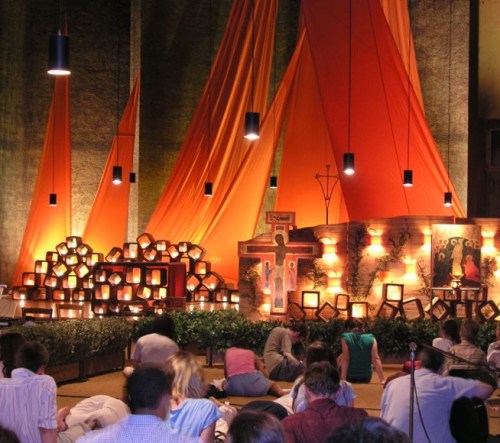
“A hundred flickering votives, the slow devotions dancing and bursting, they move wildly, beyond all control, but never seem to blow themselves out. The flame holds steady fed by whatever the source of wind is here inside the sanctuary. The Spirit in us, we dance, we burst, we do not sit still containing His numinous light. How is it that they move so? Do my votives at home move like this? Gold orbs. I make them the fruits of the spirit: love, joy, peace, patience, kindness, goodness, faithfulness, gentleness, self-control.
The light of TaizeThe squared chunks of chimney brick house and contain the movement, allowing the flames to dance to the edge of extinction, kept safe, protected. Like the image of the boundary fence around the pasture, it holds us in, keeps us safe, but gives us free reign to run and dance, to gambol on the green grass, to serve, to love, to rejoice. “I rejoiced when I heard them say, let us go to the house of the Lord.” (Psalm 122:1) See the way the lights are stacked, askew but balanced— not orderly, but perfect. Only the foundation bricks— the cornerstones — are at 180 degree angles. All the rest are cock-eyed, leaning, turning, holders of the Spirit, inside them the flames dance. At my feet, the reading for the night, “Above all, keep your love for one another at full strength, since love covers a multitude of sins. Be hospitable to one another without complaining. Based on the gift they have received, everyone should use it to serve others, as good managers of the varied grace of God. If anyone speaks, his speech should be, like the oracle of God: if anyone serves, his service should be from the strength God provides, so that in everything God may be glorified through Jesus Christ. To Him belong the glory and the power forever and ever. Amen.” (1 Peter 4: 8-11)

Orangina at the Oyak

After the group session I walked down to the Oyak, the Taize cafe that opens three times a day for a half an hour or so. The Brothers had come up with the idea for the small concession stand— where everything is sold at cost— to prevent vending trucks from coming into the village and taking advantage of the young people by selling them snacks at jacked-up prices. It was hot and I wanted a cool beverage and although I’ve never ordered an Orangina in my life (the name’s just too funny) in that warm afternoon, when my throat was dry, it was the most refreshing thing I’d every had. Cost: 40 cents US. I leaned up against a cafe table and began to pull at the threads of a recurring thought. “Can something be considered evil if the person doing it doesn’t know any better?” It was a question Rasmus had asked in our group— the only time he’d broken off from his duties as Michael’s translator (Opting for Joy, 1 & 2) to pose his own question. We had been discussing the idea of distinguishing between a person and the offense.

The argument toggled back and forth— both in the group and now in my own metronomic mind— between “is it really possible that they don’t know?” “Is not His word planted within each of our hearts?” “Do we not choose the path of light or dark?” and then the matters that spill from theology into the areas of child development… But What About…”children who are raised in extremist conditions? Who are taught only hate, war, darkness, violence? Do they really know? Can they know?” and then another outgrowth to consider “Are we viewing evil as being equal to sin, or is it an extreme, chronic and unrepentant form of sin?” “And if sin is the equal of evil, and if we are all born sinful, are we all not, also, evil, whether we recognize it or not?” But, But— Around and around I went, sipping my Orangina, snacking on a bag of Fair Trade paprika-flavored Yucca Chips.

I had learned a new term in a Bible study that spring. Curvatus in se. It was first used by St. Augustine to describe sin as “man turned in on himself.” It was the most revelatory description I’d ever heard and had helped me immensely in my understanding of sin. But still I wrestled with the idea of Original Sin, and the notion of children being sinful by nature when so much of their self-centered behavior is simply age appropriate and essential to growth at different stages. But, but— I was just about to flip this idea over on its head again when a man approached.

“May I join you?” We exchanged quick pleasantries, introductions —he was visiting from Germany, probably a little older than me— but then we both fell back into parallel silences filled with our own thoughts.

“You look like you have a lot on your mind,” I said, calling myself into the moment.

“Yes,” he said, “I have come with two serious problems to consider.”

Phew, I thought. So it wasn’t just me sitting here in the sunshine in the Burgundy hillside arm-wrestling with Original Sin. This oughta be good. “What are the two problems?” I asked.

“Well, my sister and I had a quarrel before I left and I’m thinking I’ll have to mend things when I get back.”

“Oh,” I said, somewhat disappointed by the scope of his concern. “And the other one?”

“My son has just finished his studies and now he needs to find a job and I’m wondering what I should do to help.”

“How old is your son?” I asked.

“Twenty-eight.”

I buried my smile in my Orangina before responding. Some answers are solved by theology and some by child development. “Don’t do anything,” I told him. “Your son is a grown man.”

“I know,” he said, sheepishly. “But-”

“He’s going to have to figure it out for himself.”

“But-”

There are answers we don’t want to hear, but have to. Hard truths at the Oyak cafe.

Talk amongst yourselves

empty chairs I felt blessed beyond measure to see that the two salt-n-pepper Brits who I had grown so fond of on Wednesday had decided to leave a little bit later so that they could be with us for one more group session. Sometimes I wonder if people realize when they don’t show up for a something— a book club or a meeting or a dinner party— how much they are truly missed. Our discussion focused on the Compassion section of the Letter from Chile and it was rich and lively and challenging to be sure! But rather than summarize the thoughts of the group in Taize, I thought it would be nice to hear your thoughts. Consider these: an excerpt, a study prompt, and a quote from the footnotes.

“We are all familiar with that reflex of self-protection which consists in wanting to keep ourselves safe even at the expense of others. And it seems to be becoming more pronounced in our day, as feelings of insecurity grow. What can prevent us from giving in to fear. Is it not by reaching out to others, even to those who seem to be a threat?”
—Br. Alois, Letter from Chile

“Why does Jesus say: Whoever has seen me has seen the Father (John 14:9)? How does the life of Jesus change our understanding of God?”
—from Br. John’s study prompts

“Achieve inner peace and thousands around you will be saved.” — Seraphim of Sarov, a 19th-century Russian monk

Do they speak to you? And if so, how? Pull up a chair. I look forward to reading your thoughts.

Irreconcilable Differences

All that night and through the morning prayers I wrestled with the notion of reconciling the seemingly irreconcilable. Aware now that there were two sides to the sanctuary, I found myself on the right, with the Protestants, and eyeing the priests on the left (I realized now they were not just Brothers but ordained priests) who were serving the Catholic faithful. The glib voice in my spirit wanted to cry out, “Seriously?” Do any of us really think that Christ would delight in these divisions? Shouldn’t we all be a little bit ashamed for allowing them to continue. And yet I knew, this was deadly serious stuff, not so much for me, who was not really raised in the church and did not cleave to these distinctions— most of which seemed to me to be based on proving that one camp or the other had a stronghold on the real, real Christian truth— but for millions of people around the globe who declared proudly and righteously that they were Baptist or Episcopalian or Catholic or Lutheran. What can I say— human beings are inclined to choose teams and then spend a lifetime shouting, “We’re number one!”

In the U.S., the divide in Christendom seemed to me to be far less about Catholics and Protestants and more about politics. A few decades back, just about the time the dwindling wealthy, white majority realized that they would be needing a very large pool of voters to stand a chance in Hell of staying in power, they encouraged the creation of the Religious Right, a group which began to brand Christianity in the eyes of the secular world as a force of judgment and small-mindedness. Gone was the grace, compassion and joy. This was a new strain of an old finger-wagging faith, more concerned, it seemed, with taxes and other people’s sins, than with reaching people who longed for wholeness with the love of God. And so it was that the divide in Christian America came to be between those who endeavored to live out their faith in their everyday lives, especially the calls to justice, mercy, and the Great Commission, and those who believed that God had called them to be vocal, unyielding, and devoutly capitalist and to reclaim this as the American way. So shrill and snarky and utterly political have the voices of the latter grown that most nonbelievers in America don’t even realize that there is such a thing as the quiet faithful, when in fact, we are the majority.

I left the morning prayers in a fog, shuffling through the food line, filling my tray with roll and chocolate and my cup with coffee and powdered cream. I sat with a few of our new English friends, and a few others whom I hadn’t yet met. I can’t remember how the subject came up, but it was a subject that was often on my mind of late, one that dovetailed easily into this larger schism: the new challenges in male and female roles. I shared with the group my growing concern about men in their 50s and 60s who had been cast out of the workplace before their time, and, due to a grueling economy, might never find the dignity of good work again. They were becoming more and more bitter and I feared for their lives, their families. “I think for a lot of them, the idea of having to adapt and learn new skills is just too much. Woman are used to having to adapt. This is one of the reasons they’re becoming increasingly successful.” Several of the people at the table nodded, leaned in. “That and the fact that the female management style tends to be better at bringing out the best in all members: most men still have a kill-or-be-killed approach.”

The man to my right had not said much but when he did speak, I could tell that he was English, likely not from a big city. His face reddened, “Is that so?” he said, and physically pulled away.

“Well, that’s been my experience, yes,” I said.

“Well, what I’ve seen is that a lot of asserting women have pushed the men out and robbed them of their dignity.”

I froze. It seemed clear that I had become in that moment one of these women to him; I recognized now that he was one of the angry, cast aside men. He got up to clear his tray and I wondered how I would manage to speak to him again. All through the day I thought about him, about how, if I could understand his pain, his point of view, I might better be able to connect to those men I knew who were struggling back home. He was nowhere to be found at lunch, but just before the afternoon groups I saw him in the tent. “I’ve been thinking about what you said all day.”

“Really?” He looked startled, curious, maybe even flattered. But not angry.

“Would you mind talking with me a little longer. I’d like to understand better what you meant about the asserting women pushing the men out.”

We talked for a half an hour, while our respective groups hovered in the distance. He was surprisingly quick to share with me his own pains, how he had been raised by a distant father and vowed he would never be that way with his own children, how he did everything possible to be there for his wife and kids— the soccer games, the family outings, the providing for— until ten years in, his wife up and left him for another man. We talked about the fragility of the family unit, the downside of women’s independence, and the matter of giftedness regardless of gender. Finally he laughed, “Hell, we all know that woman are better at getting things done.”

And when we hugged, I brushed up against the reality of communion. This is my Body, broken for you. And the path to reconciliation.