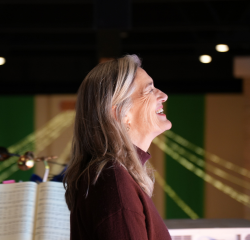
….It was hard to imagine getting our little ragtag group back to a comfortable level of dialogue, let alone a fluid, exultant exchange, but that one simple question, asked after an instant of prayer, transformed everything. How does the life of Jesus change your understanding of God? The answers came, one after another, from Val and Hele and Michael and Rasmus. We talked about how, were it not for Jesus, we would see our spiritual interactions as being all about us and our connection to the divine source of power. How without Jesus, God was distant, removed, maybe even gone altogether but with him He became immediate, intimate, instructive. But mainly we talked about how Jesus’s life modeled for us how to live with one another: how to serve, to love, to show mercy, to defend, to build up, to listen to and be patient with.
One of the small groups I led back home— all women, most successful in worldly terms— had coined an expression that always made us laugh at ourselves. “It’s easy to love people….as long as you aren’t trying to get anything done.” A companion adage might be, “It’s easy to love people….as long as you don’t have to spend much time with them.” But here in Taize there is no getting away from people, not if you’re heeding God’s call through Christ to work in, with, and through them, to be both blessed and blessing, which can only happen in relationship with others. This is the difference that the life of Jesus made in our understanding of God.
Alistair cleared his throat.
“I work long days,” he began. “Legal consulting,” he added vaguely. “And when I get home, I like to have a few glasses of wine to relax.” The group froze, did not lean in closer so as not to unnerve him in any way. “It’s not that I drink too much — I don’t— that is not the issue, but I work very hard all day, and I need that downtime.” The group was ready to leap over, to hug him, to nod in agreement, but he continued. “But sometimes I wonder if having my wine is being unfaithful to my obligations as a Christian, because, it’s occurred to me — it’s never happened, but I’ve wondered about it— if a friend were to call me at 10 or 11 with a flat tire, or after a row with his wife, or there was some emergency with a family at church— would I be able to help or advise them to the best of my ability. And the answer to that, I’m embarrassed to say, is no.”
Like bees to the hive we swarmed, kissing his wounded spirit with gratitude for his honesty, his humility, and maybe even more than that, for his holding up a mirror for each one of us. I, too, was a high-achiever who enjoyed a glass of wine in the evening to wind down. “I just need to be off duty sometimes,” I confessed. Val seconded the motion, and Michael, from the confines of his wheel chair and the torments of his wracked body shouted out, “Yes!” There was a sense that each one of us, to a greater or lesser degree, carried with us some guilt over not being able to be “good enough” servants; that even when we took our rest, we suspected we could be doing better.
In that, I realized, we were all missing the most important way in which the life — and death— of Jesus changed our understanding of God: that we are forgiven. And that our endless human mess, as we had all just had the good pleasure to witness, could be endlessly redeemed in Him.
Amen
 Heather Choate Davis
Sometimes, the most difficult Scripture to fathom is while we were yet sinners, Christ died for us. We are thoroughly undeserving, and cannot earn forgiveness by any means. Why is it so hard to accept a gift like grace?
I think your question “Why is it so hard to accept a gift like grace?” would make a rich and compelling study theme:)