Valuables redux

To really appreciate this story you have to have read the post “Money Changes Everything.” Go ahead: I’ll wait. Ok, so, where were we. Ah, so it’s Friday evening just after the workshop and the dinner and I needed to go down to the office and let them know about our departure plans on Sunday. It was a beautiful evening, and I felt a certain lightness that led to a burst of spontaneity— I know! How ’bout since I’m down here, and it happens to be the 15-minute window of time that the Valuables Counter is open, and there are only a few people in line, why don’t I just get everything out of there now. The crowds were already starting to grow and I just wanted the whole process to be done with.

“Hello!” I smiled brightly. The stern young girl, whom I’d taken to referring to as German, nodded. “I decided I’d go ahead and pick everything up early.”

“May I have your slip?”

My what? “Um,” I said, fumbling through my little backpack; my belongs had been reduced to such a small selection that there was no clutter to sort through. If there were a slip here, I would see it. “I don’t think I have it anymore.”

“Well I can’t release your valuables without the slip.”

“I think I might have lost it.”

“Well you’ll need to look for it and come back.”

“But what if I can’t find it?” I wondered if this pattern of conversation was sounding as familiar to her as it was to me.

“Why don’t you look for it, and we can see how things stand after that.”

“But you know me. You checked the things in. My passport and my driver’s license are in there. You can match my face to the pictures so you know the right person is getting it.”

“I’m afraid I can’t do that. Please have a look and come back tomorrow,” and with that she moved onto the next person.

Gone was the feeling of lightness, of spontaneity. I retraced my steps. If I didn’t have the slip, where was it? It must have been, I decided, in the empty passport case that I returned to my aunt after I’d check everything in. She would have it. I would go back to the room before Evening Prayers and she would have the slip and I would not have to worry about it all weekend. Naturally, worrying and stewing were entirely up to me and not at all in keeping with the Spirit of Taize; what can I say, we mortals get it wrong a lot.

Back in the room we set out on a hunt for the empty passport case which I was now certain had the slip in it; half an hour later, with the room upturned, we could find neither the case nor the slip. A trip to the Lost and Found would now be needed. I would go right after the service. I would close the loop and find peace. And so it was, with my head full of sturm und drang, I entered the sanctuary for prayers.
How do we hear His call?

By the weekend the 5:45 workshop options had multiplied. I chose “God at work in us: how do we hear His call?” and found myself in a large room filled almost entirely with twenty-somethings. Was the question of vocation simply more relevant to the young, or was it that older people had stopped asking questions they didn’t want the answer to— or maybe felt they already had. The idea of calling was profoundly important to me. I had read Parker Palmer’s book Let your Life Speak many times— even led a retreat based on the material— and was now eager to hear what a brother from Taize would add to my growing understanding.

He was late. And when he did finally arrive, he seemed unprepared. He had the jittery, showy energy of a street mime, making fun of the title of the workshop, I suppose as a way of endearing himself to the young people. I tried to remind myself that the brothers were there, first and foremost, to live our their vows to Christ and the community, and second, to reach the young. Whether or not I liked him was of absolutely no consequence. Still, there were two things I remember well from that hour:

First, the Brother referred us to Matthew 19:17, the story of the wealthy man who feels he’s done everything right, has kept all the commandments, and now wants Jesus’s assurance that he will have eternal life. “If you want to be perfect,” Jesus says to him, “go, sell your belongings and give to the poor, and you will have treasure in heaven. Then come, follow me.” (Matthew 19:21) Part of the Brother’s point in recounting this story was to show how the man, who had approached Jesus with the term “good teacher,” was not being sincere. He was trying to use earthly ways, such as flattery, to sway him. The second point was that the wealthy man claimed with confidence that he had kept all the commandments, an unlikely claim, and one that would not be for him to judge— again, arrogance where there should have been humility.

But I think the most essential point was the question of whether or not the man really felt he was being “called’ to the next level of commitment, or if he were simply looking for a blanket “no, you’re good, you’re great” that would cover him for the rest of his days. What opened up to me as the Brother spoke was this: If the desire to know the answer was sincere and had been planted in the wealthy man’s heart by God, then the man would not have had any trouble accepting Jesus’s invitation. Even though he had great wealth, that would pale in value to the opportunity to live out his personal calling.

“Most of us,” he said, “Think our Call is supposed to be big and flashy and long-suffering, but that is not the case.”

He went onto tell a story of how he had been doing service work at an orphanage in India and there had been a young Westerner there volunteering. It was clear that he was miserable. He didn’t like the Indian people, or the food or the flies; he didn’t seem to have any gift for working with children, or for tolerating discomfort of any kind. Most of his summer was spent griping to whomever would listen. When the Brother suggested to him that he really shouldn’t be there, the young man said, “But isn’t this what we’re supposed to do? Help the poor?”

It was a valid question, and it reflects a mistake a lot of us make. I frequently feel that if I were really, really committed, I would been in that orphanage with him, doing the hard, messy, selfless, service work. But I would likely be as unhappy as he was, because there is nothing in me that points in that direction. None of my gifts, none of my life experience, none of the things that give me joy. Trying to live out someone else’s vocation— no matter how cool or impressive it sounds— doesn’t honor God, or the individual.

Here’s what the Brother suggested: If you want to practice serving the poor, start small. Help your poor mother with the dishes. Help your poor father with the yardwork. Help your poor neighbor with the kids when they seem overwhelmed. Start there and see what grows. This is how your ears will become better attuned to God.

Alistair the Barrister, redeemed

….It was hard to imagine getting our little ragtag group back to a comfortable level of dialogue, let alone a fluid, exultant exchange, but that one simple question, asked after an instant of prayer, transformed everything. How does the life of Jesus change your understanding of God? The answers came, one after another, from Val and Hele and Michael and Rasmus. We talked about how, were it not for Jesus, we would see our spiritual interactions as being all about us and our connection to the divine source of power. How without Jesus, God was distant, removed, maybe even gone altogether but with him He became immediate, intimate, instructive. But mainly we talked about how Jesus’s life modeled for us how to live with one another: how to serve, to love, to show mercy, to defend, to build up, to listen to and be patient with.

One of the small groups I led back home— all women, most successful in worldly terms— had coined an expression that always made us laugh at ourselves. “It’s easy to love people….as long as you aren’t trying to get anything done.” A companion adage might be, “It’s easy to love people….as long as you don’t have to spend much time with them.” But here in Taize there is no getting away from people, not if you’re heeding God’s call through Christ to work in, with, and through them, to be both blessed and blessing, which can only happen in relationship with others. This is the difference that the life of Jesus made in our understanding of God.

Alistair cleared his throat.

“I work long days,” he began. “Legal consulting,” he added vaguely. “And when I get home, I like to have a few glasses of wine to relax.” The group froze, did not lean in closer so as not to unnerve him in any way. “It’s not that I drink too much — I don’t— that is not the issue, but I work very hard all day, and I need that downtime.” The group was ready to leap over, to hug him, to nod in agreement, but he continued. “But sometimes I wonder if having my wine is being unfaithful to my obligations as a Christian, because, it’s occurred to me — it’s never happened, but I’ve wondered about it— if a friend were to call me at 10 or 11 with a flat tire, or after a row with his wife, or there was some emergency with a family at church— would I be able to help or advise them to the best of my ability. And the answer to that, I’m embarrassed to say, is no.”

Like bees to the hive we swarmed, kissing his wounded spirit with gratitude for his honesty, his humility, and maybe even more than that, for his holding up a mirror for each one of us. I, too, was a high-achiever who enjoyed a glass of wine in the evening to wind down. “I just need to be off duty sometimes,” I confessed. Val seconded the motion, and Michael, from the confines of his wheel chair and the torments of his wracked body shouted out, “Yes!” There was a sense that each one of us, to a greater or lesser degree, carried with us some guilt over not being able to be “good enough” servants; that even when we took our rest, we suspected we could be doing better.

In that, I realized, we were all missing the most important way in which the life — and death— of Jesus changed our understanding of God: that we are forgiven. And that our endless human mess, as we had all just had the good pleasure to witness, could be endlessly redeemed in Him.

Amen

Alistair the Barrister

After our morning Bible study, one of our new English friends dropped us off in the nearby town of Cluny— home to the first Benedictine monastery— for a walk-about and some lunch. We scrambled to get a bus back in time for our afternoon study group, which was now comprised of me, Michael, who could not communicate on his own, Rasmus, Michael’s main helper, Michael’s second helper, Hele, a nice Danish woman who spoke limited English, my aunt (who felt like taking the afternoon off), and Val, who had joined us the day before. She was one of those lively, chatty, country women who lived either in Scotland or France or both —it was hard to track all the details with her— but whose joyful spirit was a welcome addition. We had just found our little spot on the lawn when a new man approached. He reminded me of an oversized Colin Firth, simultaneously awkward and pompous. We welcomed him and, after learning that his name was Alistair and he was from Britain, we dove right in, turning to a quote by Father Basil Gondikakis. He was the abbot of a monastery on Mount Athos, who used mystical, poetic language to express his thoughts.

“With the example and the help of the Virgin, every peaceful and transparent soul, open to the divine will,
can become a Mother of God, according to grace, conceiving and giving birth to a little joy that transcends death.”

Beautiful, I thought, as the circle fell silent, pensive, grateful for the words. “Alistair,” I said, wanting quickly to engage him, “What do you get from this passage?”

He shifted his bulky frame in the small metal folding chair and said, “Well I don’t think there’s much to get. It’s fairly superficial.”

“Really?” I said. “How so?” I began to fear that he was so much brighter and more advanced theologically than the rest of us that my delight in the passage was about to be shown as folly.

“Well it’s about parenting, obviously. And I suppose that’s helpful for some. I mean, I know people who are always looking for parenting tips in the Bible and of course there aren’t any.”

I didn’t know where to start. The entire group fell dumbstruck. I don’t think I’d ever led a group of adults in which someone had missed the mark by that much. “I’m not sure it’s really about parenting,” I said gently. “I think it’s trying to say something about how each one of us —men and women alike — can give birth to a special kind of joy and hope, if we’re willing.” I quickly turned to the others. “That’s just my thought. Did anyone else have anything?”

“Well, I agree with Heather,” Val said, which didn’t seem to please Alistair. She then went on for another 7 or 8 minutes expanding —but not by much —on what I’d already said. Michael, usually a vocal contributor declined to add anything. Hele and Rasmus smiled vaguely as if a pleasant expression might help quell the growing tension. Alistair did not look at Val as she spoke, but when she was done he turned to me with his hand on his chin, his index finger posed along his cheek as if preparing to say something snide, or perhaps, have a photo taken for a book jacket. “How is it that you came to be the leader of this group?” he asked. “Are you a part of the Taize community?

“Oh, no,” I said, starting to wish I had stayed in Cluny, enjoyed another glass of Pouilly-Fuisse. “I’m just a visitor, like you.”

“I don’t understand, then, why are you leading this group?”

“Well, I guess, someone has to. I just got things started earlier in the week and it’s sort of stayed that way.”

Val chimed in, her hand on my back. “Heather does an excellent job. We’re very glad to have her.”

“Would you like to lead instead, Alistair? I’d be happy to have you do it.”

“No, no,” he said. “That wasn’t my point.”

“Well, would you like to pick the next discussion question?” This would be hard for him to do, as he had not read any of the material in advance, not because he didn’t have time, but because he seemed to find it all, in the words of Family Guy’s Peter Griffin, a bit “shallow and pedantic” for his tastes.

“No, no, you go ahead,” he said, and returned his attention to the patch of grass at his feet.

I looked at my lap, thumbed through the question prompts and the short readings, prayed silently for guidance. Looking up I decided we’d get a fresh start. “Let’s move onto Br. John’s questions for a minute. Question 1: How does the life of Jesus change our understanding of God? (to be continued)

Jesus, the name of God (yikes!)

I don’t know what it’s like where you live, but in L.A. it’s much safer to drop the F-bomb than the J-word in mixed company. If you’re in the South— Mississippi, Alabama, Texas— droppin’ Jesus’s name is no more controversial than ordering a Coca-Cola, but in the major coastal cities of the U.S., it simply isn’t done: say the name Jesus at a bar-b-que in West L.A. and be ready to be talked about later, and not kindly, with the emphasis being on your intelligence and lack thereof. Why? You could say Mohammed or Buddha or Wicca Master all day long and no one would bat an eye. What is it about the name of Jesus that is so shocking, so unnerving, so divisive?

On Friday morning, Br. John continued his talk on the name of God, speaking now, specifically, of Jesus Christ. He began to identify Him by his different roles and relationships. Jesus, the Son of God. Jesus, the Word of God. Jesus, “the image of the invisible God” (Colossians 1:15). And he said something particularly interesting and, at least to me, new: that our name is the part of us that turns towards others. It exists for the purpose of creating relationships. We delight in people knowing and remembering our names. We struggle to remember the names of others so that we might connect, or reconnect, with them. “A person’s name is, to that person, the sweetest most important word in any language,” according to Dale Carnegie. The name Jesus is the part of God that is seeking to be in relationship with each one of us. It is an invitation. An opening. God with a name tag on at the company mixer: HELLO, my name is….

Scary.

It has become common parlance for the very people who would never use the name Jesus with reverence to exclaim Jesus Christ! (Or, a variation, Jesus H. Christ— not sure what the H is supposed to stand for). It is almost always used at the point of exasperation or rage; why? Are they trying to blame Him for something? Are they asking him to solve something? And if Jesus is nothing more than a fairy tale for the weak, low-aptitude masses, then why bring Him into it at all? Why not mutter Pinocchio or Lancelot or Harry H. Potter? Why is it that the word Jesus Christ is buried in our psyches to spill out like a reflex in the first place?

“I have put my words in your mouth and covered you with the shadow of my hand–I who set the heavens in place, who laid the foundations of the earth, and who say to Zion, ‘You are my people.'” (Isaiah 51:16)

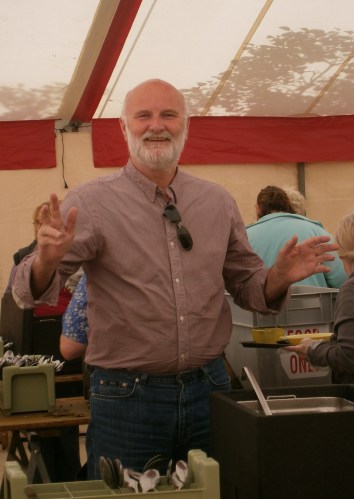
And so it is we have in Christ the name and the word and image of God. And in His people, the face of God made real through the love of Jesus.JoepKarin w/ Joep Here, my friends Joep and Karin from Holland (love the Dutch!) and the most luminous Chinese man, whose name I never got, but whose smile and joyful service as he cleared the dish tubs inspired me each and every day. If I knew how to form the characters to write Jesus in Chinese, I would call him that.Chinese friend