Welcome to Taize!

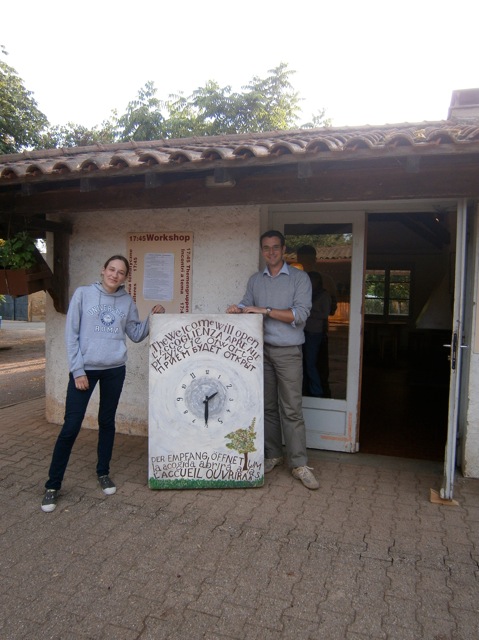
We'll be open soon REV

The bus dropped us off in a cloud of dust. We rolled our suitcases and our duffels up to the welcome center. It was closed. Across the way there was another gathering area of sorts where two beatific young people told us we could park our things until the center reopened in a few minutes. Already the pace of life had slowed to an easy smile. It was the gift of being in “prayed up” space, a feeling that I had each and every time I arrived at St. Andrew’s Abbey back home. The air was simply thick with grace. The welcome center opened and out came Jean-Patrique, a man with dark brown Indian skin and the whitest, most life-giving smile I’d ever seen. “Welcome to Taize,” he said and reached for his clipboard. He has been a brother in the community for most of his adult life, greeting well over 100,000 visitors a year. Whatever weariness might come from a job like that was not evident in his face. I was reminded of the Benedictine rule, to “greet all as Christ,” and although Taize was not a Benedictine community, they seemed to borrow from the best of all traditions.

There was still some discussion about which room we were to be assigned to. We prayed silently —well, maybe not so silently— to be able to be somewhere without a lot of roommates. Or any roommates for that matter. Jean-Patrique would let us know what was possible later. In the meantime, the most ebullient, clean-cut, catalog-handsome, almost embarrassingly enthusiastic young German man with uber-hip glasses approached. “Welcome to Taize. I’m Stephan. Would you like some tea and cookies?” I didn’t particularly want either but couldn’t bring myself to say no to young Stephan, who filled our little plastic cup-bowls with lukewarm tea and grabbed us each a handful of individually-wrapped, butter biscuits.

We sat on a bench outside in the shade as he went through all the orientation information. There were services three times a day. We would be assigned to the Adult tent for our Bible Study and meals. Our group leaders would place us in a small group for daily discussion. There was a singing rehearsal every day at 2:00, if we wanted to learn more about chanting the songs, and thematic workshops on a variety of subjects every evening at 5:45— all optional. Stephan, we would learn, is what they call a “permanent,” a young volunteer who commits to live and work in Taize for weeks, months, or even years to help the brothers manage the steady flow of visitors and, for some, to consider a livelong call there. This week he was assigned to the welcome center.

“And where are you from?” Stephan asked, not perfunctorily, but as if our very presence was the greatest joy of his young life.

“California,” I answered.

“OH!!” Stephan shouted, clapping his hands together. “We just had someone from California here last week. Ryan.” Stephan peered at us hopefully, but stopped short of asking if we knew him. “We just love people from California. You all just seem to glow!”

And in that moment, I imagine we did.
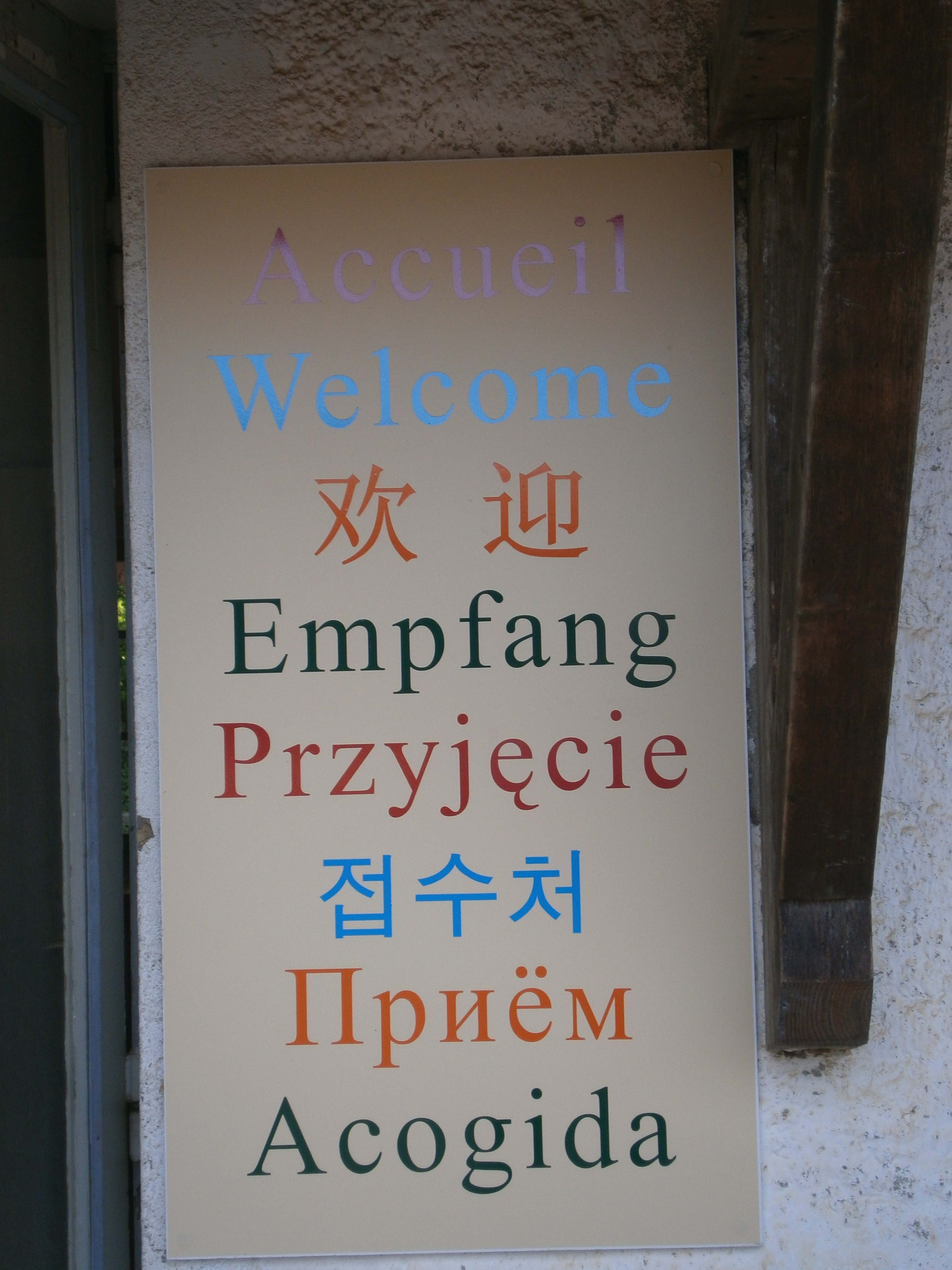
Welcome sign

And we’re off…..

The Paris Gare de Lyon station was bustling on a Tuesday morning. We were told it was because of the holiday. “Ascension Day,” the ticket clerk said. Huh. According to the liturgical calendar recognized by most of the free world, Ascension Day was on a Thursday, six days earlier. (I know stuff like this now). “And you better get your return ticket today, because all the returns next weekend are selling out, too.” I stared blankly. “Pentecost,” she explained. I tried to imagine going into any workplace in America — a nation where there are more than twice as many churchgoers as there are in France — and saying you’d be taking a six-day weekend to celebrate the Ascension and, if the Spirit moved you, might just be gone straight through til Pentecost.

“And there are only a few seats left on Monday, as well,” the ticket clerk warned. I leaned forward in an effort to comprehend. “Whit Monday,” she said.

“Naturellement,” I smiled.

The train was packed with young families, students, older couples. A young father helped us load in our suitcases, redeeming the entire male population of France. We settled into our assigned seats, a grouping of four. There was only one person opposite us, a large, scowling, gypsy of a woman, who grunted and buried her head in a paperback as we settled in. The club car was right behind us and we could hear the merry voices of the young vacationers. I pulled out my travel Bible. I had promised my aunt I would give her some guidance as to how to navigate the sometimes daunting book before we got to Taize. Although she’d been baptized and confirmed, run a pre-school program at an Episcopal Church, and maintained a childlike faith her whole life, she had never read The Bible or done any sort of Bible study. This was not uncommon for women of her generation, who were merely asked to make sure the family was dressed nicely for church and didn’t do anything scandalous.

“Ok,” I said, “Lesson one.” I proceeded to measure out 3/4 of the pages between my thumb and index finger like a fat steak. “This is all the Old Testament.” My aunt went wide eyed. The woman across from us harrumphed. “Jesus doesn’t even come onto the scene til the very end.” I adjusted my grip to pinch the final sliver of pages like found treasure. “This, here, is the Gospel of the Lord.”

Suddenly the woman across from us lurched forward and glared at me. “Can’t you just stop talking and read a book!”

I suppose I was meant to be intimidated, to feel guilty that we, in our quiet chat, had somehow been more intrusive than the rowdy partyers spilling into the aisle “drunk with new wine.” (Acts 2:13). I was not.

“We’re going to be talking for a little while longer,” I informed her calmly. Returning my attention to the subject at hand, I split the pages right down the center and continued. “Now, right smack dab in the middle of the Bible, you’ll find the Psalms, the bridge to the Judeo-Christian tradition…..”

Here’s what I knew about Taize before I went…

It was in France. The music I loved came from there. It was sort of a monastery, but not exactly. It was ecumenical, which means that it did not belong to any denomination but welcomed brothers and sojourners from all Protestant and Catholic churches (and no doubt some thirsty seekers of other backgrounds, as well). This was unheard of in the monastic world, or even the church world, and the reason that they called their sanctuary The Church of Reconciliation. Taize was like a mecca for young people: in fact, their doors were primarily open to visitors 16-29. Those of us over 30 were welcome only during certain weeks and seasons, only for a short time, and never in groups larger than five. The living conditions were very simple. We would sleep in sleeping bags in bunks in shared rooms. There would be chores. My aunt and I prayed in advance that we wouldn’t have to clean toilets. I laughed at the ridiculousness of my decision to take my one golden ticket all the way to France where I would be asked to do the one chore I wouldn’t even do at home. God’s sense of the ironic is humbling.

The signs were everywhere

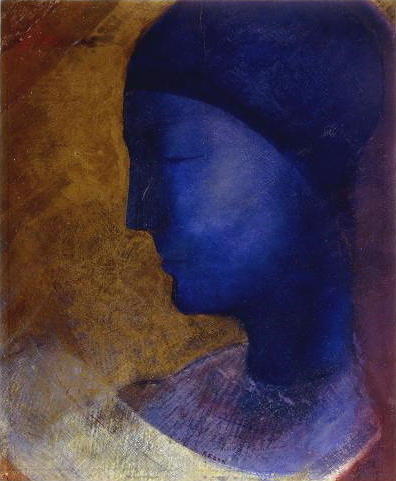
I arrived in Paris early on a Sunday morning to meet up with my aunt. She had been travelling through Europe with her husband, whom we planned to send home in two days while we journeyed onto Taize. But for 48 hours it was nothing but champagne and roquefort and pain au chocolat and tartes de citron and Evian sipped in the steam bath of the spa at the Park-Hyatt. Earthly pleasures are good indeed:) My aunt had selected a gallery show for us to tour on Monday. I can’t remember now what it was— I just remember that as we were walking I began to see signs: Odilon Redon, The Prince of Dreams, Grand Palais. I had come to know the work of Redon when I was creating the Renaissance Service. To me his later work was like a visual representation of the music of Taize, which I had used to introduce and close out each of the arts-based vespers. We continued to walk toward the little gallery, map in hand. Arriving at the front door we exchanged just enough broken French with the greeter to realize that the show she had in mind had come and gone in June of 2010!! I smiled. “Why don’t we go to the Grand Palais? I’d love to see the Redon.” And so it was that a brisk walk later, I was surrounded by the work that had started it all, my sense of the arts as a window to the divine. The work that is represented in this blog by the ship on the right, “The Mystic Boat,” and by the tiled images of “Christ and His Apostles” that comprise the background of this very page. It was, to me, the art of Silence.

The music called to me

The first time I ever heard a chant from Taize I was not even remotely a Christian. I was a young mother of a four-year old, and an 8-month old who had recently been diagnosed with a brain tumor. Brain tumors tend to make smart, sophisticated secularists get down on their knees and beg like babies. As my daughter lay in a hospital bed at UCLA, someone told me about a special prayer service at a nearby church: All Saint’s Episcopal Church in Beverly Hills. Huh. Strange. That was the church where I had been baptized and confirmed—not that any of that had stuck. So off I went to the Wednesday evening service. It was packed. I couldn’t figure out when the special prayer part was. I couldn’t figure out how to follow the bulletin (which, at the time, I didn’t know was called a bulletin). By the time I could find any of the hymns in the book, they were on the last verse. But then the people started singing the simplest, most hauntingly beautiful refrain I’d ever heard. “Jesus remember me, when you come into your kingdom.” Again and again they sang it til even I could not resist joining in. The people began to process forward for—what? Communion. Yes, communion. And we sang and we walked and it was warm and safe and for a moment I brushed up against the mystery of faith. That was 17 years ago. That was my first experience of Taize.


http://www.taize.fr/en_article681.html