Favourable Wind

My daughter is at the airport as we speak, heading off to Colorado for a month of summer school to study drawing. It’s an exciting time but there has been some trepidation, as well, mostly about the chaos of the airport and the margin for error in getting from here to there. I turned to one of my favorite devotionals this morning, “The Desert of the Heart,” which features short excerpts from the writings of the early desert fathers, and this is what I read:

“Three monks met unexpectedly at the river bank and one of them said, ‘I ask as a gift from God that we should arrive at our destination without fatigue in the power of the Spirit.’ Scarcely had he prayed when a boat was found ready to sail together with a favourable win and in the twinkling of an eye they found themselves at their destination, although they were travelling upstream.”

Godspeed, my beautiful girl. May you be blessed with every good thing.

Many rooms, many seasons

Just read a wonderful piece by Mike Cope about how we experience and express our faith in very different ways: enjoy!

Do you ever feel out of place with fellow believers—perhaps like no one “gets” you? It may simply be that you are a “winter believer” while they are “summer believers ” (or vice versa). Let me explain …

Summer believers are confident that God is still doing great things. They have regular reports of what God is doing, what God has taught them, what God has “put on my heart.” They worry about the deistic tendencies they see of others who don’t share their perspective. Faith makes sense, the world works pretty much like they’d expect. They have stories of amazing ways God has healed, provided money, sent specific guidance, etc. They want an upbeat worship style that reflects the joyous news that God is already alive in the world.

Winter believers are convinced that God is God. But they often walk in doubt and mystery. They feel like they’re not “in on” all the amazing stuff people say is happening to them. They don’t hear regularly from God. The problem of evil and suffering seems vexing. Their observation is that people with faith are healed at just about the exact same rate as those who have no faith. They read the dark journal of Mother Teresa, well up with tears, and nod. They prefer a worship style that recognizes the strong dose of “not yet” that we currently experience as we groan and wait.

What would it mean for us to live together in peace? What if…

…Winter believers prayed for their summer brothers and sisters, willingly listened to their confidence in God, decided to assume the best about their spiritual journey, refused to label them, and entered into their expressions of worship (for the sake of the other)?

…Summer believers prayed for their winter brothers and sisters, willingly listened to their questions, decided to assume the best about their spiritual journey, refused to label them, and entered into their expressions of worship (for the sake of the other)?

A mark of maturity is when we realize that we are not the standard by which others are measured. There is actually strength in our diversity. Perhaps together we can shoot for, say, autumn. And that doesn’t sound bad!

Mike Cope is a minister, author, lecturer, and prolific writer whose blog, preachermike.com, has been visited by four million people in the past six years. A widely respected national figure in Churches of Christ, Cope will direct Pepperdine’s Bible Lectures program beginning May 5, 2012.

Grace in the Parenting Storm

It was hard to ignore all the media swirling around the Time magazine cover on “attachment parenting” last week. The shot of the mother nursing a boy who appeared old enough to play t-ball was designed to stop us in our tracks—it did, good job with that—still, I found myself curiously unstirred about the issue at hand. After all, my kids are raised, I’m happy with how they’ve turned out, there are no grandchildren yet to fuss over—I’m in that lovely place where I can sit back, smile supportively, and watch the next generation work themselves into a lather about parenting choices.

My interest was, however, piqued on Sunday during a sermon that had nothing to do with parenting, but rather, the verse “abide in my love.” When I heard it I couldn’t help but picture all the moms with baby slings. How that’s the very message they are trying to communicate when they hold their babies so close to their bodies that their pulses become one. Abide in my love. How that’s exactly what God is trying to tell us when He knows our every worldly instinct is to cut and run. Abide in my love. Funny how the very thing that advocates of attachment parenting are trying to model has been the model for how we are to live in relationship to God and each other from the beginning of Creation.

Of course, this new “trend” in parenting is not in the least bit religiously motivated—in fact, I suspect many of its biggest fans would be somewhat horrified to hear there is any corollary at all.  At the same time, many of the people who are the most vocal about their faith are likely disgusted by what they see as the indulgent, bohemian methods of attachment parenting. (Aren’t the culture wars fun?) Still, there it is, the first word on attachment: “As the Father has loved me, so I have loved you: abide in my love.” (John 15:9) 

 According to the non-profit group Attachment Parenting International, their goal is helping parents raise “secure, joyful and empathic children in order to strengthen families and create a more compassionate world.” Compassion, therefore, is the end game, and kids who know they are loved, that their needs will be met, that their cries will be heard, will grow to be more compassionate people. In Hebrew, the word for compassion is rahhum, which means “a deep, belly-rooted connection.” It comes from the word rahamin—literally, “a mother’s womb.”  It is used all throughout Scripture, perhaps most notably in the passage from Exodus 34:6 when God describes his very nature as “merciful and gracious, slow to anger, and abounding in steadfast love and faithfulness.” In a perfect world—to which attachment parenting advocates may be trying to help us return—every child would have the perpetual security of knowing that they are loved and attended to in the same way that God loves and attends to their parents, pulling them close, keeping them secure. 

At least that was the plan. But, human nature being what it is, we tend not to like any plan but our own, certainly not some dusty, old, pre-iWorld plan. And so new parents, particularly those who were not raised with any connection to the original “playbook,” or who were—but badly—seek out a new one. A list of tips, of guidelines—a new, cooler bible—that will help them make sure that their lives, and their children’s, will all turn out beautifully. So William Sears offers up the Eight Principles of Attachment Parenting. And Miguel Angel Ruiz provides The Four Agreements. And educated, urban parents—often leading proponents of attachment parenting— look for serenity in The Four Noble Truths, dressing their closely-slung progeny in Buddha-themed onesies, somehow overlooking the irony that in that lovely, Eastern philosophy, attachment is the origin of suffering.

Therein lies the rub: that love is equal parts attachment and suffering, and so one needs to search for a source of truth and grace big enough to embrace them both. For all the beauty of the attachment parenting movement, those Eight Principles simply do not address the reality that one day those well-loved children will climb out of their parent’s bed and into their own grown up lives, and they will face challenges and sorrows, no matter how well-adjusted they are. They will, at times, be lonely or afraid or unsure of what value their wonderfulness has to the world. For all their exceptionalism, people will still manage to hurt them. And when that day comes, those grown children will cry out in the night, just as people have since the beginning of time (if you doubt that, read the Psalms), and they will expect someone to answer. But mom and dad will no longer be standing on the other side of the door.  

And so it might be useful to add a 9th principle: one that lets kids know that, in addition to their earthly parents, they have a heavenly father. One who knows them better than they know themselves. One who asks only that we stay close enough that He might hear our cries.

The cover photo looks like this: a baby is held in the arms of his parents who are nuzzled in a sling against the breast of God. Think it’ll sell?


(This is also running now on HuffingtonPost.com)
In Praise of Old Women with Cellulite

I hear them before I see them, their voices rising up in sing-song and echoing off the greenhouse dome that covers the pool at our local YMCA. I can’t tell what they’re singing, only that they sound happy and spry—more like a schoolgirl choir than a pool full of women in their final decades. Crossing through the lobby, I can see them now, wielding day-glo noodles as they raise their slack, dimpled arms skyward, laughing and bending and jogging and singing and raging against those two great adversaries: time and the temptation to deny aging. There are no facelifts here. No distorted lips, no tummy tucks, every one of them a portrait of lumpy, vital, sagging perfection.

It used to be we had lots of chances to see real old age firsthand. American families lived in multi-generational homes, or in cities where seniors and grade-schoolers shared the same stoop. And always there were the churches, where families young and old, and singles in search of love and a place to belong, would gather together as if it were the most natural thing in the world. But we don’t go to church much anymore, and if we do, we tend to cluster by age or politics or musical preference. As it is, the YMCA may just be the last true, multi-generational experience in America.

This weekend, I’ll turn 51 and the fact of the matter is this: age comes with spots, with wrinkles, with fannies that have lost their umph. Lips do not retain the fullness of youth, eyes do not stay alert at all hours. And I thank God every morning for these women who dare to bare their puckered thighs and their kangaroo midriffs and their bright, carefree smiles, shouting with their very presence that there are more important things in life than looking young. We need desperately to hear this. Because until we make our peace with the loss of our youthful appearance, we’ll never be able to face the fact that we’re all going to die one day.

Now, depending on whether or not you have any sort of faith practice, that is either a terrible thing for me to say or a simple truth that brings you only a passing sorrow. For me, everything I need to know about death can be summed up by a single line from St. Paul, “whether we live or whether we die, we are the Lord’s.” Now, I can’t say what these beautiful old swimmers hold in their hearts as they splash and sway, but I have no delusions that their entire days are spent in this giddy state. They have lost things, these women: husbands, savings, relevance, daily contact with children and grandchildren who live worlds away. They know that their days are numbered and the quality of those days will be different from the ones of their youth, when they no doubt came to this same pool with young children, looking then like the visions of Esther Williams they hold now in their mind’s eye as they twirl against the warm, forgiving water.

I took my mom to see The Best Exotic Marigold Hotel yesterday, a gem of a movie filled with nothing but 60 and 70-plus actors trying to find peace—and perhaps something of the spark of youth—in their last season of life. Depending on how deep we’re willing to dig, to yield, to reinvent, anything is possible. Still, I don’t imagine I’ll be spending my old age in India (although none of them did either), or even in my imaginary “home by the sea,” where I can read all day in a hammock swing while my husband Lon paddles out in the surf. More likely I will spend my later years in the pool at the local Y. Thanks to these beautiful old women who rise each day to celebrate the simple pleasure of moving their bodies and staying connected to the human family, this does not feel like a sad ending. In fact, I’m kind of looking forward to it.

(this will be featured in the Huffington Post this weekend)

Aren’t you tired?

Image

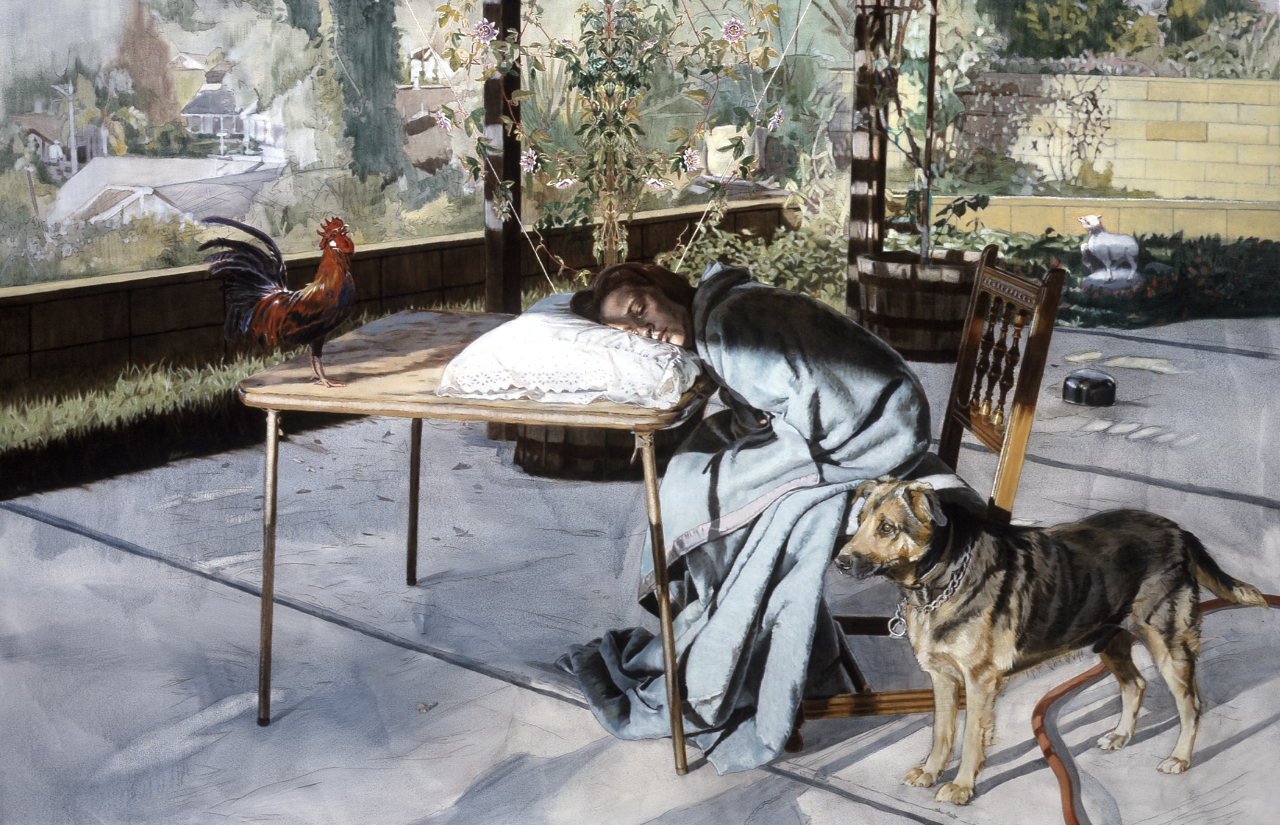
This painting (The Passion) by Patty Wickman was the very first image of the very first Renaissance Service (TM) I ever did. Imagine entering a candlelit sanctuary at night with this projected up big on a photographer’s seamless on the altar…as if to say “Come unto me, all who are heavy laden, and I will give you rest.”(Matthew 11:28)

I share it in honor of my last day of a very demanding semester. And for all who still hunger for that deeper rest.

Pax

Heather