Have you ever been to Heaven?

Taize altar CU

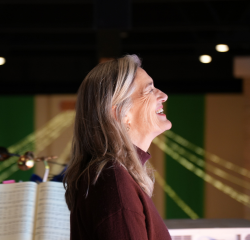
Me neither. But the sanctuary at Taize may just be the closest thing to it. The walls soar to cathedral heights, but there’s nothing old or gray or obsolete about the beauty here: everything is orange and glowing and rendered with an eye to simplicity. We approach in silence, pick up a songbook and enter the otherwordly space. There are no pews in Taize. All the pilgrims sit on the floor, or on a handful of freestanding wooden kneelers which people learn to arrive early to snag. The center aisle is partitioned off from the two sides by a small row of dried greens that form a divide between the visitors and the brothers, who sat in an order that appeared to be by age, or seniority, in simple wooden chairs along the edges or in kneelers down the center.

In their white robes they entered, one by one, from behind a wall just off to the side of the altar; they did not process in any formal way, but seemed to arrive, much as the members of a symphony would, just in from whatever workshop or prayer meeting or meal they had been attending, and now dressed in white robes and appearing to glide. I watch enrapt as they entered the space. Tried to let go of the noise in my head from the events of the day. I looked up at the icons, at the orange flames of silk cloth that rose up along the back of the altar. I said to myself again and again You’re here now You’re in Taize You’re about to sing in a service in Taize. I kept repeating it to myself to make it real. On several of the side walls, there were small LED lights that indicated the number of the song that will be sung next. I opened my book and found so little English I wanted to weep, but here the words to all the songs were written and translated, so you could sing in the original language or in your own. I decided to sing in Polish, in Italian, in Latin, in French, in German to hear the words on my tongue, to see if they might draw me closer to the God of all the earth.

There are two things that are essential to a Taize service: singing and silence. The chants are rarely more than two sentences long— sometimes only a few words—so that they can be repeated again and again till they take hold in the spirit of the singer. There is no formula for how may repetitions there will be. Sometime a song can go on for 15 minutes. Sometimes twice that. And always, at the center of the service, where traditionally a sermon would go, there is silence. Deep, thick, pure silence held prayerfully by hundreds (or thousands) of people. The silence lasts for at least 6 minutes and often closer to 12. The brothers claim that most visitors complain, at first, that the silences are much too long, and, by the end of their journey, not nearly long enough.

It is these moments of silence, silence like a deep well, that are the great sublime gift of Taize.

Money changes everything

There are no keys to the rooms in Taize which spreads out over 250 acres of the Burgundy hills with a public road running straight through the center. Visitors are told not to bring things of value, but still there are passports and cameras and credit cards. We are strongly advised at check-in to turn our valuables over to the security desk at La Morada. The counter is open twice a day. For fifteen minutes. I didn’t wear a watch and I hadn’t brought my phone so the notion of trying to catch a 15-minute window of time — when our room was as far from the welcome area as geographically possible —was daunting. “Give me your valuables,” I said to my aunt after dinner. “I’m going to run down there and try to get this out of the way before worship.” She handed me her entire wallet and her passport case and I high-tailed it across the property. The day was beginning to catch up with both of us. Hard to imagine I had awakened on a down pillow with a glass bottle of Evian on my nightstand; now my head was spinning with languages and logistics and fatigue.

There was one person ahead of me at the valuables desk. Most of the 400 people present that day at Taize had checked in on Sunday; by the weekend there would be at least ten times that many. How this 15-minute system would work when they were at capacity was beyond me. I mulled over the irony of having to check one’s valuables while staying in a community whose mission statement was “A pilgrimage of trust on earth.” When at last it was my turn I smiled at the fresh-faced young girl in charge, handed her my aunt’s things, plus my own passport, driver’s license, and credit card. “Here you go,” I said. “Do I need to sign something?”

“First, of all,” she informed me, “You must take everything out of the wallet.” She pointed to a sign on the wall behind her with that very message and I suddenly found it easy to picture her at 40, wagging her finger at her children. “Seriously?” I protested, slowly complying. She handed me a sheet of paper which I promptly put my name on and turned toward the door. “No,” she said, gesturing towards the paper. “You must write down each item. Here. On this list.” Mulishly, I crossed off the boxes that read passport, cell phone (my aunt’s), credit cards, cash, and handed her back the sheet. “I can’t imagine you can get many people through this whole process in 15 minutes,” I commented pointedly. Whatever glow I’d arrived with was quickly fading. She offered a tight smile and corrected me again. “No. Here. You need to write down the names of each of the credit cards individually. And you must give an exact count on the Euros.” Responses came to mind but they were not appropriate for a community of peace seekers. I took a deep breath and began to go through my aunt’s stack: gas cards, airline cards, department store cards— she’d brought her entire wallet with her. The girl who I’d decided was not fresh-faced at all but exceedingly rigid now began to prepare the sealed envelope for the safe. “We ask that you do not try to claim anything until you’re ready to leave.”

“But what if we have to?” We in the free world like to keep our options open.

“We ask that you do your best not to make that necessary,” she advised. Realizing I’d likely want to go to the ceramics store again before the crowds arrived, I retrieved my one credit card. “I’ll just hold onto this, then,” I said, smiling, trying to get some sort of brownie points for supporting the system. “So what happens if we miss the window on Sunday morning before we have to leave?”

“Then we’ll have a problem.” Clearly she were not trained in the customer-was-always-right school of hospitality.

“What do you mean we’ll have a problem?” I suddenly imagined throngs of visitors blocking the valuables door and our not being able to get our passports out before she flipped the closed sign, pulled the blinds.

“We have many other things to do here in the community. We can’t stand at this desk all day,” she said. “Do try to be here on time.”

And with that I made my way towards the doors to the Church of Reconciliation.

Behute mich, Gott, ich vertraue dir….

No sooner had the Icon workshop ended than we found ourselves queuing up outside the giant white circus tent that would be our home for the next week. I saw a woman carrying a crate of trays up from the kitchen and offered to help; just like that I had a job. Her name was Kathryn and she was from South Korea and I would discover, as we worked, that she had taken a year off to travel the world. She had multiple graduate degrees from Harvard, and had worked in public policy and the non-profit realm in DC before returning home to try to use her gifts in her native land. The men there would have none of it. And so now she travelled and prayed and served, and waited for her next cue. “Do you think you’ll go back to Korea?” I asked as we set out crates of the one and only utensil provided in Taize: a large spoon. “No,” she said, wistfully. “I can’t contribute there.”

Two young female leaders— permanents, like Stephan; likely no more than 20— stood up on a bench outside the tent. “We still need three volunteers for clean-up tonight. Three volunteers.” Well, as anyone could see, I was already busy! “Whoever cleans up gets to go first through the line!” This small incentive coaxed a few people forward and we were onto the next order of business, which seemed to be voting on the grace. Voices shouted out, “Frieden, Frieden…,” “Glucklich sind…,” “Que j’exulte et jubile…,” “Meine Hoffnung….” I didn’t hear a single suggestion in English: what were these songs? Were these local folk songs? The words sounded primarily German. There was a consensus: “Behute mich, Gott.” Everyone started to sing. I couldn’t even hum along— was just starting to catch hold of the tune when it ended and the porcelain-skinned brunette leader cried out,”Bon Appetit!”

I shuffled into the tent somewhat confused and with the slight sting of feeling on the outside. “Where do those blessings come from?” I asked the taller of the two leaders, Anna, a young German girl with cornrows and tribal headbands. “They are all the Taize chants,” she replied. “Have you never heard the music?”

“I’ve heard lots of the music, but in English,” I said as if that should have been my passport to the great songbook of the world.

“Well, you’ll learn,” she smiled and checked off my meal card. I was handed a tray, then a single shallow bowl that doubled as a plate which a man scooped a hearty serving of pasta into. Moving down the line, each server smiled and bid some sort of good wishes for my meal in accent-laden English. There were slices of bread and foil-wrapped pats of butter and little packets of cookies and a lovely peach. I took them all, realizing suddenly that my lunch had been a bag of chips at the bus depot. I began to worry that I would be hungry later. I began to worry that every single song we’d sing all week would be in another language. I began to worry that I didn’t really know anything about this place, or this music, or why God had called me here. I looked over at my aunt who was already deeply engaged in conversation with a English couple close to her age. I turned the other way, put on a friendly face and introduced myself to the man across from me. His accent seemed Germanic. “Did you know that blessing song?” I asked. Sensing my discomfort he patted my hand and smiled. “In English it means: Keep me, O God, for I trust in you. You show me the path of life. With you there is fullness of joy.”

http://youtu.be/DpmlQOTFEeE

Icon Workshop 5:45!

Ascension icon cropped Do you know anything about icons? Not the little technology-based dingbats you click on to, say, share a blog, but the kind that people of faith use for devotional purposes. They are used most often in the Greek and Eastern Orthodox traditions, but can be found in almost any spiritual practice: a time of meditation before a Buddha could also be considered a form of connection through a visual symbol.

We arrived at the workshop a few minutes late. There were nearly a hundred people seated on simple wooden benches and listening enrapt. Clustered around the room, people were translating the Brother’s comments (which, to my great relief, were in English) into German, French, Italian. A large icon was propped up on an easel at the front of the room. Like most icons, it was flat in appearance with a strong use of gold and featuring key biblical characters. The icons I was familiar with were typically of a single face, usually Christ, but sometimes Mary, or Mary holding her son. The idea of praying with icons is not unlike a woman in labor zeroing in on a focal point; by harnessing all your energy and concentration towards that one image, you can endeavor to transcend your earthly reality. For a Christian, the use of icons allows an opening in the spirit in which to commune with the Living God.

I knew all this before I came to Taize. What I didn’t know was that icons could also be depictions of whole narrative scenes with multiple characters. The one at the front of the room featured Christ in a white robe bending down as if to bid farewell as he slowly rose up above the crowd. It seemed to be a visual representation of the Ascension, an event that went unseen by human eyes.

“You see here there are twelve people surrounding Jesus,” the Brother said, and we all nodded, confident that they were the 12 disciples. Most of the apostles are not singled out in the icon tradition, he told us, but a few will have distinguishing marks. “This one here is Peter,” the disciple to whom he gave “the keys to the kingdom of heaven” (Matthew 16: 19) And this one here, the Brother continued, “Is Paul. He is usually easy to identify as he is the bald one with the beard and the reddish, brown robe.” Many around continued to nod and smile. I did not. A decade ago, I couldn’t have told you who Paul was, but in that moment the brakes in my brain skidded violently: Wait a minute! Paul wasn’t even on board at the time of the Ascension. He was still called Saul back then, the world’s greatest persecutor of the early followers of Christ, a man who wouldn’t see the light til years later during his fateful journey along the Road to Damascus. And although he went onto be one of the great evangelists in human history, writing letters of encouragement, guidance, discipline, teaching, and spiritual development to the early home churches— what I call the “ians” books of the Bible; Colossians, Corinthians, Thessalonians etc— he was never one of the twelve disciples. And what about Judas? And what about Matthias, the one who was chosen to replace Judas?

The Brother interrupted my internal monologue to comment on these very issues of “artistic license” and I smiled privately. Oh. Somehow, someway, by some miracle of faith, all those hours and moments and days where I had committed to reading scripture studiously, prayerfully, religiously, some of it— not just the spirit of it, but the facts of it— had actually started to stick. This, in that moment, felt like a revelation.

Toto, we’re not in Paris anymore

So here’s the deal with the rooms. My aunt, who had just turned 70, was invited to stay in the guest house where there would be a real room, with real beds— two to a room— and a real bathroom just down the hall. But I, who had not just turned 70, would not be able to stay with her there. I would have to go sleep with another group somewhere else. My aunt did not hesitate. “We want to stay together.” In that case, we had two choices. I could sense that Jean-Patrique was really going out on a limb for us here; although the brothers endeavor to greet all as Christ, they have a firm rule of no special favors. All must be treated equally. It’s the only way community works. We were given an option of a dorm that was close to the other adult quarters that we would share with a few other people, or a room that was “a bit removed” from the main area that we could have to ourselves. “We’ll take that one,” we said and delighted in the fact that, at least according to the map, we would be off in a stretch of rooms that bordered a private park with walking trails.

“Wonderful!” we chimed.

We then eyed our luggage, two rolling bags— the weeklong, not the weekend size— and two duffels filled with sleeping bag, pillow, sheets, towel. We looked around to see if, perhaps, someone might help us get the bags to the room — the room which was just a bit removed. I turned and saw Stephan smiling by the door. “We’ve got a long way to go with these bags,” I said playfully. You, know, just in case he wanted to take a hint. “Yes, but you’ve got plenty of time.” He waved and went back inside, and we were left alone in the dust.

Have you ever tried to roll two bags up an unpaved slope of dirt and rock? How ’bout down one? “Are you doing alright?” I asked my aunt periodically as we stopped to rest on the way to our room. I was stopping more often than she was as my duffel bag shifted and flopped and toppled my flow every 20 yards or so of the near-milelong trek. All the way down the hill, we talked breathlessly about how blessed we were to get this special room in this special location all to ourselves. My suitcase hit a crater and toppled. My aunt kept going, fearing the loss of momentum. “I’ll meet you there,” I said, muttering in a way that might be considered profane.

And when, at long last, we found it, tucked away at the end of a string of rooms, two rows deep, ours on the inside —not the forest side —with a lovely view just outside our front door of a retaining wall, a curious slope of mud and grass and the back end of someone else’s barracks, there was not another soul in sight. Three bunks and a metal luggage rack and small window to crack for air. And no neighbors.

Our own little slice of heaven in Taize.

(Photo: my aunt Anne in our new digs)

Anne in room