Oh, for the faith of Don Mattingly

It occurred to me as I was reading the sports section this morning, that following a baseball team over the course of a season is really a narrative of injuries, lapses, and defeats— and overcoming them. The pitching rotation is suddenly a real time tryout for the top of the farm crop. Too many outfielders is somehow not enough to solve the problem of batting average. The bearded wonder loses his mojo with no guarantees that it is not a slump but the onset of the final decline. And the errors…oh how they test one’s forgiveness.

Donny Baseball seems to take it all in stride. Kershaw out for the first six weeks? We’ll just make some adjustments. Ellis out for just as long. Ditto. Puig as likely to have an owie as a place in the starting line up. He’s learning. While Doyers fans the world over wail and gnash their teeth (well, at least the 30% of them who get Time Warner and can watch the games), Donny M keeps his wizened gaze steady and offers his boilerplate response, “We’ll see where we’re at tomorrow.” I watch him in the dugout for a sign that one of these days he’s going to snap. To lose his deep and abiding faith that, despite all evidence to the contrary, the Dodgers are the greatest team in baseball in the year 2014 and destined for a World Series win. Don Mattingly doesn’t blink. It’s as if he is the living, breathing embodiment of Matthew 6:34 “So don’t worry about tomorrow, for tomorrow will bring its own worries. Today’s trouble is enough for today.”

I have no idea what the manager of the L.A. Dodgers actually knows or believes about God. But he teaches me a lot about what faith looks like played out against the daily upheavals of our perfectly ordinary lives. And for that, I am grateful.

In a few hours, the ever stellar and deeply devout Clayton Kershaw will return to the mound. Just as Donny knew he would. May the Lord bless and keep them both.
Special Ops

Lately it seems that every time I turn around I’m somewhere I don’t fit in. I keep listening to the voice inside my head that I’ve come to know and love as God’s, and it keeps leading me to the strangest places. I’m studying things deeply that I never thought I’d have any interest in—and still am not sure how I’ll use. I’m sitting with people whom I’m quite sure are not “my people.” And yet—somehow—they are. And I’m being somehow led to tend and care for those on the fringes in ways that no one will ever know about, knowing only that I might just be the only person willing or able or available to do so.

A dear friend of my calls this Special Ops. I think she might be onto something. Let us be mindful when we’re called to do and be things—and enter into new places—that are not at all comfortable, and not at all clear, that they might be part of some Divine Navy Seal mission that we’ll never fully understand. Or need to. Somehow, I think I can live with that. In fact, I’m starting to think it’s the only way to live.

Why Growth Hurts

“Imagine yourself as a living house. God comes in to rebuild that house. At first, perhaps, you can understand what He is doing. He is getting the drains right and stopping the leaks in the roof and so on; you knew that those jobs needed doing and so you are not surprised. But presently He starts knocking the house about in a way that hurts abominably and does not seem to make any sense. What on earth is He up to? The explanation is that He is building quite a different house from the one you thought of – throwing out a new wing here, putting on an extra floor there, running up towers, making courtyards. You thought you were being made into a decent little cottage: but He is building a palace. He intends to come and live in it Himself.”
C.S. Lewis, Mere Christianity

Where to begin?

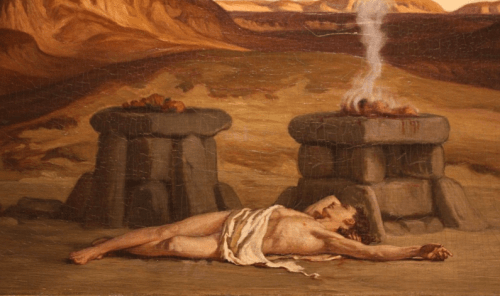
"The Death of Abel" by Elihu Vedder
“The Death of Abel” by Elihu Vedder

For many people the events of Holy Week are mysterious in a wholly confusing way. What in the world does a man dying on a cross 2000 years ago have to do with us? they ask. This image helps us know where to begin. It portrays the first death in the Bible, from Genesis 3:8-11, in which Cain, the first son of Adam and Eve, kills his brother Abel out of spite. It is from this story that we get the saying,”Am I my brother’s keeper?” as Cain denies any knowledge of his slain brother’s whereabouts. His tone is not unlike his father Adam’s when he tries to shake of culpability for eating the forbidden fruit by blaming not only Eve, but God for sending her to him. The apple doesn’t fall far from the tree.

From that moment on, a cycle of violence, selfishness, retaliation, and death became a force in the family tree of all humanity for which we could never make amends. Until Him.

“For if we have been united with him in a death like his, we will certainly be united with him in a resurrection like his… The death he died, he died to sin, once, for all.” (Romans 6: 5 & 10)

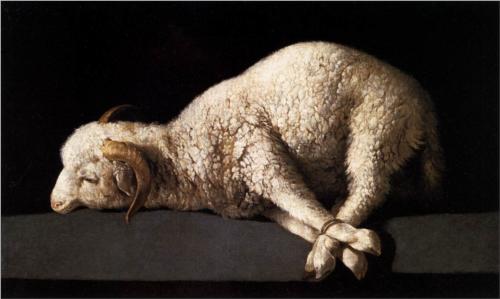
Agnus Dei by Francisco de Zuburan

Wisdom

“Eventually it comes to you: the thing that makes you exceptional, if you are at all, is inevitably that which must also make you lonely.” Lorraine Hansberry, Journal entry, May 1, 1962