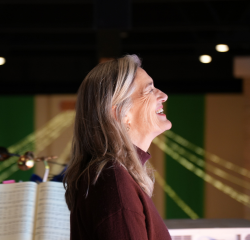
Healed by song

Advent is a time of truth-telling and so I will tell you this: I have a horrible singing voice. But I love to sing—Christmas carols in their season— and throughout the year, the chants of Taize. I know that I feel more human, and more free of the burden of being human, after belting out in the safe space of my own car “Fall on your knees, oh hear the angel voices.” For some, that specific narrative— and the way it has been played out in contemporary American culture— gets in the way of the hunger for God that is universal. This has led many to the divine practice of Gregorian chant, of which Taize is a form. Kathleen Norris speaks to this beautifully in a short chapter from The Cloister Walk called “The Gregorian Brain.” I’ve included it here, along with one of the most compelling and accessible Taize chants Veni Sancte Spiritus.

The Gregorian Brain

Recent neurological research has shown that in religious rituals from around the world, poetry is generally chanted with a pulse of between two and four seconds, a pulse that the researchers now believe to correspond to an internal system in the human brain. This system, epitomized by the traditions of Gregorian chant and plainsong in the Christian West, seems to help integrate the workings of the right and left hemispheres of the brain in processing information. As a contemporary monk has written, this may explain why “the ritual chanting of sacred texts contributes in a unique way to a profound, largely subliminal, absorption and engagement having many more dimensions than mere rational understanding.” It also might help explain the current popularity of Gregorian chant albums among people who have very little ritual life, or who have grown weary of what the monk terms “poor talkative Christianity.”

Monastic people have long known — and I’ve experienced it in a small way myself— that the communal reciting, chanting, and singing of the psalms brings a unique sense of wholeness and order to their day, and even establishes the rhythm of their lives. This is why they keep going back to choir, even though it may seem monotonous. This is why Benedict termed the Liturgy of the Hours the “Work of God,” why Benedictines today still speak of it as the foundation stone on which they build all the other work that they do. Now it seems that their conviction has a neurological basis in the brain itself.

The scientists have also confirmed what Thomas Merton knew from experience, that “Gregorian is good, and it heals.” I know from my limited experience of singing chant that it fosters faith: I believe better and more thoroughly when I’m singing it. Like so many elements of monastic life, Gregorian is a matter of focus. It teaches us what we gain when we become simple, dependent upon the beauty of the unadorned human voice. It teaches us what we lose, in music, when we add a melody and a beat. It also fosters an appreciation for community. Gregorian can’t be sung alone: you need people who are willing to blend their voices in such a way as to sound like one voice. In practical terms, Gregorian makes you extremely grateful for the other people who are singing with you. When you hit a note feebly, making more a groan than music, someone else will cover for you. When the time comes, you’ll do the same for them. when you need to take a breath, someone else will keep going, making a continuous flow. The flow of Gregorian music reminds me of the pulse of ocean waves, steady and incessant, but never superfluous, a satisfying sound that may swell unpredictably before ebbing back in silence. It is a music in harmony with the body, and with the universe itself. It is also, always, praise of God.

Music is serious theology. Hildegard of Bingen took it so seriously as a gift God made to humanity that in one of her plays, while the soul and all the Virtues sing, the devil alone has a speaking part. The gift of song has been denied him.

TAIZE: Veni Sancte Spiritus (Come Holy Spirit)

You just never know

What do you think of when you think of Andy Warhol? Campbell’s Soup? All-night parties? Pop-art album covers for the Rolling Stones? You might picture a slight, frail, near-albino artist in tortoise shell glasses, but you probably wouldn’t picture him in the back pew of a Catholic church, genuflecting devoutly. But that’s where he was, several times a week for his entire adult life, his devotion to Christ a quiet, even secret, affair. Few people knew that he was a regular at a New York City homeless shelter where he served meals and spoke tenderly with the visitors. Nor that he painted 60 pop-art versions of The Last Supper, an entire series of crosses, another one of Madonnas, a Colorform-esque painting of twelve eggs, symbolizing the disciples, and a Madison Avenue-style poster that proclaimed, “Heaven and Hell are just one breath away!” On his nightstand, where, if his public persona was to be believed you’d find bottles of amphetamines, was, instead, a crucifix. When his funeral was held at St. Patrick’s Cathedral, the art world was confused.

Truth is, we never know another person’s heart. And although their deeds will often reflect their beliefs, often times they reflect them clumsily, or imperfectly, or like the reclusive Andy Warhol, privately.

So today— heck, maybe all the way from now til Christmas— let’s try to assume we know nothing of what’s in another person’s heart. If we picture them, let us picture them like this: bathed in gold and holding in their secret hand the symbol of Love.

Andy Warhol, Untitled (Gold Hand with Creche), 1957. This is his own hand, holding a symbol of the Christmas folk ceremonies from his parents' native Mikova

Andy Warhol, Untitled (Gold Hand with Creche), 1957. Warhol’s own long-fingered hand holds a little creche, suggesting his familiarity with the Christmas folk ceremonies brought by his parents from Mikova in the Slovak Republic (The Religious Art of Andy Warhol, Jane Daggett Dillenberger, 1998)

Listening to Life

Five years ago at Christmas, my son Graham gave me a book by Parker J. Palmer called Let your Life Speak. He didn’t know anything about it, found it on a table in the spiritual books section of Barnes & Noble, thought I might like it. It has, over these past five years, become one of the touchstones of my life, key words about who we are, who we were meant to be, and how we are to listen for the voice of vocation. If I could, I’d buy you all a copy. Instead, I’ll share the opening page or two and trust it will begin to open doors for you as it did for me.

He begins with a poem by William Stafford, Ask Me:

Some time when the river is ice ask me
mistakes I have made. Ask me whether
what I have done is my life. Others
have come in their slow way into
my thought, and some have tried to help
or to hurt: ask me what difference
their strongest love or hate has made.

I will listen to what you say.
You and I can turn and look
at the silent river and wait. We know
the current is there, hidden; and there
are comings and going from miles away
that hold the stillness exactly before us.
What the river says, that is what I say.

“Ask me whether what I have done is my life.” For some, those words will be nonsense, nothing more than a poet’s loose way with language and logic. Of course what I have done is my life! To what am I supposed to compare it?

But for others, and I am one, the poet’s words will be precise, piercing, and disquieting. They remind me of moments when it is clear— if I have eyes to see— that the life I am living is not the same as the life that wants to live in me. In those moments I sometimes catch a glimpse of my true life, a life hidden like the river beneath the ice. And in the spirit of the poet, I wonder: What am I meant to do? Who am I meant to be?

I was in my early thirties when I began, literally, to wake up to questions about my vocation. By all appearances, things were going well, but the soul does not put much stock in appearances. Seeking a path more purposeful than accumulating wealth, holding power, winning at competition, or securing a career, I had started to understand that it is indeed possible to live a life other than one’s own. Fearful that I was doing just that— but uncertain about the deeper, truer life I sensed hidden inside me, uncertain whether it was real or trustworthy, or within reach— I would snap awake in the middle of the night and stare for long hours at the ceiling.

Then I ran across the old Quaker saying, “Let your life speak.” I found those words encouraging, and I thought I understood what they meant: “Let the highest truths and values guide you. Live up to those demanding standards in everything you do.” Because I had heroes at the time who seemed to be doing exactly that, this exhortation had incarnate meaning for me—— it meant living a life like that of Martin Luther King Jr. or Rosa Parks or Mahatma Gandhi or Dorothy Day, a life of high purpose.

So I lined up the loftiest ideas I could find and set out to achieve them. The results were rarely admirable, often laughable, and sometimes grotesque. But always they were unreal, a distortion of my true self— as must be the case when one lives from the outside in, not the inside out. I had simply found a “noble” way to live a life that was not my own, a life spent imitating heroes instead of listening to my heart.

Today, some thirty years later, “Let your life speak” means something else to me, a meaning faithful both to the ambiguity of those words and to the complexity of my own experience: “Before you tell your life what you intend to do with it, listen for what it intends to do with you. Before you tell your life what truths and values you have decided to live up to, let your life tell you what truths you embody, what values you represent.”

–Parker Palmer

I pray that each of us finds a bit of silence today so that we might listen to what our lives intend to do with us.
Pax
Heather

The thin crayon line

We enter the close of 2011 as members of a nation with very clear dividing lines: red state/blue state, pro-this/anti-that, a worldview of cynicism/a worldview of hope. Now, during what we once called Christmastime but now call the holiday season— correction, the holiday shopping season (apparently the only thing we could agree on was the imperative of buying stuff)— we navigate the stark divide between those who find the Christmas story to be as real as the spark of light in a baby’s first smile and those who dismiss it as nothing but an old folk tale clung to by simpletons. How, if God made us to be His children, have we become so divided…. from Him, and from each other? In her book New Tracks, Night Falling, Jeanne Murray Walker shares a poem that speaks to this quite beautifully.

We Have Nothing to Fear but Fear Itself

There were days heaven seemed easy.
Days it came right down,
drifting into my hair like pollen.
Then it seemed natural to pray.
Then everyone showed up in my prayer.
Talking was prayer, unlocking the door was. In those days,
I was all praise and thank you’s,
without even moving my lips.

People will die for less—
to be taken into the sky like that,
to walk as the holy do, without
exegegis, without needing to explain.

Now
the clouds about Chestnut Street
have clicked shut, locking us out.
One day we have a hunch. Next day
a grudge divides us.

Oh, to live before we made
separations our thesis. As if
a child had drawn a line with a crayon:
here’s the sky, here’s the earth,
here’s a woman, here’s everything else.
Its name is Enemy.

Longing for reconciliation in this season of hope,
Heather

The gift of forgiveness

Someone wrote to Dear Abby yesterday suggesting that the greatest gift this time of year was the gift of forgiveness. It’s free. It fits all shapes and sizes. And everyone needs it, the giver as much as the receiver. But forgiveness isn’t something that can be given without a shift in the heart that is often times beyond our human capacity. We like to hold onto our slights. We steer clear of the hard work of making things right with those who we’re not entirely sure deserve it.

Last year we participated in a challenging study called Peacemakers in which they clarified something about forgiveness. “It’s not a matter of forgetting, but rather a commitment to never bring it up again.” And just like that, we let it go, freeing those entangled in anger and disappointment to move forward in grace.

I don’t know about you, but there are people I need to forgive this year. I find that when I’m feeling mulish, a little humor helps loosen my grip. To that end, I share with you one of my favorite poems, a short verse by Scott Cairns:

On Slow Learning

If you have ever owned
a tortoise, you already know
how terribly difficult
paper training can be for some pets.

Even if you get so far
as to instill in your tortoise
the value of achieving the paper,
there remains one obstacle—
your tortoise’s intrinsic sloth.

Even a well-intentioned tortoise
may find himself, in his journeys,
to be painfully far from the mark.

Failing, your tortoise may shy away
for weeks within his shell, utterly
ashamed, or looking up with tiny,
wet eyes might offer an honest shrug.
Forgive him.

Blessings on this Friday in Advent,
Heather