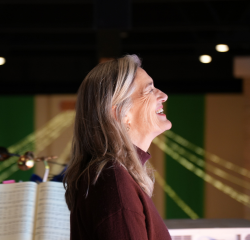
Sometimes the only way to heal the blues is to sing them. Thank you, Kate Campbell, for healing so many hearts along the way….
What are you grounded in?
As you move through your day, your week, your life, it’s a question worth asking.

Heidi Petersen “To go among the trees”
A second visit to The Seven Storey Mountain
This passage, written through Merton’s childhood eyes before he’d ever been inside a church or thought seriously — if at all — about God, speaks volumes about how our cultural landscape reflects the big picture. As we read this, we might consider what’s been lost when the keystone of our towns is a Costco or an Applebee’s or the local 12-theater Cineplex.
The church had been fitted into the landscape in such a way as to become the keystone of its intelligibility. Its presence imparted a special form, a particular significance to everything else that the eye beheld, to the hills, the forests, the fields, the white cliff of the Rocher d’Anglars and to the red bastion of the Roc Rouge, to the winding river, and the green valley of the Bonnette, the town and the bridger, and even to the white stucco villas of the modern bourgeios that dotted the fields and orchards outside the precinct of the vanished ramparts: and the significance that was imparted was a supernatural one.
The whole landscape, unified by the church and its heavenward spire, seemed to say: this is the meaning of all created things: we have been made for no other purpose than that men may use us in raising themselves to God, and in proclaiming the glory of God. We have been fashioned, in all our perfection, each according to his own nature, and all our natures ordered and harmonized together, that man’s reason and his love might fit in this one last element, this God-given key to the meaning of the whole.
Oh, what a thing it is, to live in a place that is so constructed that you are forced, in spite of yourself, to be at least a virtual contemplative! Where all day long your eyes must turn, again and again to the House that hides the Sacramental Christ!
I did not even know who Christ was, that He was God. I had not the faintest idea that there existed such a thing as the Blessed Sacrament. I thought churches were simply places where people got together and sang a few hymns. And yet now I tell you, you who are now what I one was, unbelievers, it is that Sacrament, and that alone, the Christ living in our midst, and sacrificed by us, and for us and with us, in the clean and perpetual Sacrifice, it is He alone Who holds our world together, and keeps us all from being poured headlong and immediately into the pit of our eternal destruction. And I tell you there is a power that goes forth from that Sacrament, a power of light and truth, even into the hearts of those who have heard nothing of Him and seem to be incapable of belief.
–Thomas Merton, The Seven Story Mountain, p. 41.
Random thoughts from the Olympia Day Spa
My friend Barb and I recently decided we were going to make semi-regular trips to a local women’s day spa in Koreatown part of our commitment to lifelong health and well-being. We’ve been twice. In the narrow alcove of lockers, we leave behind our clothes and our contact lenses and begin our pilgrimage from tub to sauna to salt room to steam amidst the blurred and naked shapes of a slow and steady churning of women. Old women. Teenagers. Black, brown, pasty and pink women. Flabby and taut women. All diffused in my blindness against a backdrop of steam.
I was soaking in a tub of brown Angelica herbs kept at a good 108 degrees. It’s supposed to rid me of toxins, increase my circulation, heal me of any number of urban ailments. It holds three women comfortably. There were already four of us in there when a curvy, dark-skinned black woman began to enter the tub. No worries, I thought. We’d make room. And then we heard it, a loud and angry voice from out of the steam.
“No! You! Get out of the tub! You have to rinse first!” Everyone in the Angelica tub turned toward the jacuzzi beside us to see a German woman. I couldn’t make out a single feature of her face but her accent was quite clear. As she shouted we could sense her turning pinker. The curvy black woman turned and said calmly, “I rinsed when I got here.”
“No! No! You have to rinse every time. Between every tub! Go! Go!”
Barb and I and the ladies in Tub Angelica froze a bit and wished the German woman would act a little more, well, spa like. The black woman descended another step into the nettle-colored water and said, not softly, “I guess because I’m black I must be dirty.”
The German woman didn’t speak after that. I offered the black woman the space where I was sitting. It had the best jet. “No thanks,” she said, settling in, “I just like the herbs.”
As I moved onto the shower I couldn’t help but thinking that this whole urban day spa scene is only a few details removed from an episode of Orange is the New Black. Seriously. Swap out the teal robes for orange jumpsuits and lock us in there for a few days and I guarantee we’d start forming alliances, jockeying for privileges, messing with people’s loofahs. We’d be buddying up with the Korean masseusses in their sport bra and panty sets, brokering for contraband. Or, more likely, extra salt scrub and honey rubs.
Because that’s just how we are, women. Men. People. Which got me thinking about this whole notion of purifying ourselves and how limited an act that really is. Of course it’s a lovely and life-giving thing to have heat and herbs coax the sugar and additives and alcohol and pharmaceuticals and cortisol out of our bodies, to be sure. But what about the darkness in the human heart. Where are the herbs for that? I begin to wish for a way to purify ourselves from our own worst natures, from our meanness and smallness and anger. From our selfishness and righteousness and fear. What if there was a way to loofah the ugliness right off of our bodies? An Angelica soak that would take out not only earthly toxins, but the mother of all toxins: sin? Take three steps down into the murky water and leave your demons right there in the tub. Walk away clean. Walk away kind. Walk away with love and forgiveness as loose and easy as a breath of eucalyptus-scented steam.
If you find such a spa let me know. Until then, I’ll return each day——blind and aching——to the only water that has ever been known to purify anything, and give thanks to the God who promises to “make all things new.” (Rev. 21:5)
All are welcome. And you never have to rinse first.
A visit to the The Seven Storey Mountain
I’m not sure why it has taken me so long to actually get to reading Thomas Merton’s autobiography. It became a best-seller upon its release in 1948 and has remained in constant publication since then, translated into 40 languages. Merton’s life began in France among artists, was lived out in a Trappist monastery in Kentucky, and ended in Bangkok where he was attending a conference to help find unity in the eastern and western spiritual traditions. Over the next few weeks I’d like to share some passages as I come upon them. Perhaps they will speak to you, as well.
The story begins like this:
“On the last day of January 1915, under the sing of the Water Bearer, in a year of a great war, and down in the shadow of some French mountains on the borders of Spain, I came into the world. Free by nature, in the image of God, I was nevertheless the prisoner of my own violence and my own selfishness, in the image of the world into which I was born. That world was the picture of Hell, full of men like myself, loving God and yet hating Him; born to love Him, living instead in fear and hopeless self-contradictory hungers….My father and mother were captives in that world, knowing they did not belong with it or in it, and yet unable to get away from it. They were in the world and not of it–not because they were saints, but in a different way; because they were artists. The integrity of an artist lifts a man above the level of the world without delivering him from it.”
–from The Seven Storey Mountain by Thomas Merton
 Heather Choate Davis