Silent Retreat

As some of you may have noticed, I haven’t written anything for a few weeks. It wasn’t just that I needed a rest——though the rest was nice. It was more that I don’t believe in speaking when I don’t feel I have anything to say. At least not something of value. The trouble is that the underlying reality of blogging and tweeting and working social media is that you need to be “out there” all the time. It doesn’t particularly matter what you say or show or do, or if it’s meaningful, or if the world is enhanced by your thoughts: it’s not personal, it’s math. The algorithm of search engines is designed to favor the sites and keywords and names that show up more often, regardless of the quality of the content. Which means that I undercut the whole value of having a blog by taking a few weeks off from blogging.

I can live with that.

There is a deepening in the detachment. Freed from thinking about how to present an idea in an instant, the silence begins to have its way with me.

Two things have happened during my online silence that have been significant. One, my husband Lon gave me a Kindle for Christmas, which I didn’t ask for and wasn’t sure I wanted. (He actually got it as a gift from his workplace and was delighted to pass it along). I wasn’t sure if I would like how the use of it would change the act of reading but I quickly discovered how much more easily I could engage with a broad selection of material and make it my own. On Christmas day, I found a gem of a book in their 99 cent bin. The Life of Pi is almost a decade old, but somehow I had missed it. That small but magnificent story, flipped through as if by magic, returned me to the all-consuming reverie of fiction, and the sure knowledge that there are people in the world with the courage and imagination to bring the Word of God to life in wholly original and unexpected ways. Bless you, Yann Martel.

I also began my required course in Historical Theology, which I was not at all sure I was going to like. I imagined a lot of names and dates and men making decisions that would somehow make me feel less confident in my faith. Wrong again. The textbook The Story of Christian Theology is as good a read as The Life of Pi. It begins, quite simply, as a story of writers and philosophers and ordinary people of faith feeling called to get the story right, wrestling with the testimonies of people who had walked the earth with Jesus, struggling to give shape to the teachings, to reign in the flavor-of-the month sects and cults, to formalize and defend and articulate “that which passes all human understanding,” and to ensure that if——in the grand narrative of mankind——God had intended Christ as the pivot point, they did not allow his truth to fall through the cracks.

We are assigned a half dozen excerpts each week from a range of sources: apostolic fathers, apologists (those who explain Christianity to non-Christians), persecutors, and polemicists. Last Friday, I arrived at a reading by a man named Clement of Alexandria, whom I knew nothing about— only that he wrote in the late 2nd century/early 3rd century and was not the same as Clement of Rome. I knew because I had Wikipediaed the names when I downloaded the pages so I could make data tabs that would be of some use in sorting. And so I began to read from his Stromata (roughly translated, a patchwork of ideas) and as I did I began to sit up. My fingertips pressed down on the page as if to know the source better. I began to rise, needing to move, to respond as I felt myself—-what, what was it? Quickening was the word that came to mind, the sensation so familiar to a mother’s body and a writer’s spirit. “This is my guy,” I said aloud, instantly abandoning the idea of making my central paper for the course a subset of my thesis plans. Whoever this guy Clement was, I needed to spend more time with him.

I opened my textbook and found myself at the chapter that described Clement’s life and philosophy and place in the larger story. It was there in those few pages that I found the one thing I’d been looking for almost since the day I’d become a Christian: some understanding of the radically different ways that people who claim the same faith seem to behave and express their worldview, and where and how I fit in. “Clement is the prototype of the broad, liberally minded, intellectual and philosophical Christian theologian who seeks to synthesize Christian belief with culture as much as possible.”

And in that moment, I knew where I belonged. And in the silence, I am stirring.
Everyday Saints

I met my first pastor, Kenneth Frese, 17 years ago. He’s taught me many invaluable things along the way, just as my new pastor, Chris Spelbring, young man and old soul that he is, has and will continue to. But one of the things that sticks with me is how Pastor Ken once defined for us the meaning of the word saint. “A saint is someone who, just by knowing them, makes it easier to believe in God.” I have met quite a few everyday saints over the years. I bet you have to. (If you haven’t, you may want to consider expanding your circle). Tonight, many of these everyday saints will gather at churches all over the world to worship together and mark the celebration of the birth of God made flesh— of God with us, Emmanuel. The Christ child. The Prince of Peace. You might want to consider joining them, these everyday saints, who with their lives and their daily efforts to love and serve make God a little more real for us all. I can promise you this: if Christmas feels as if it’s become just a little bit too much lately, an hour in a church on Christmas Eve will help bring it back to its humble beginnings for you.

Think about it.

Yesterday I got my annual Christmas card and letter from Pastor Ken. As always, there was a poem. As always, it was inspired. And so on the Eve of Christmas, I leave you with this short verse by Christine Rodgers:

Covenant

The world
is still
wounded-

one long
jagged scar
throbbing

And yet
this blessing.
This amazing

luminous
blessing in
the shape of

a baby comes
to us each
year. Comes

quietly, in the
midst of winter
when all seems

barren and dead-
bringing the
promise of

our deepest life.

Merry Christmas to all,
With love and His Pax
Heather

Art & Faith

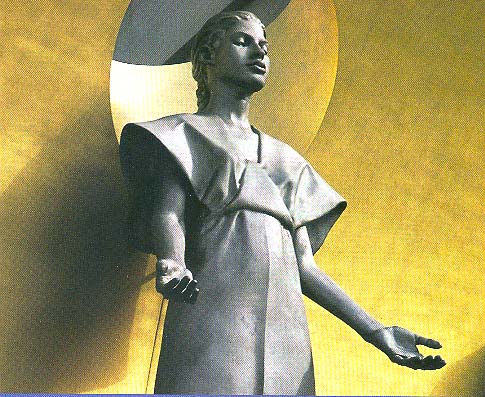
As this advent series nears its destination, I leave you with this remarkable excerpt by Madeleine L’Engle (from Winter Song) alongside Robert Graham’s extraordinary bronze sculpture of the Virgin Mary from the grand entrance to Our Lady of the Angels Cathedral in downtown Los Angeles. Whether you are an artist, a person of faith, or both, I hope they speak to you as they do to me.

The Other Side of Reason

To paint a picture or to write a story or to compose a song is an incarnational activity. The artist is a servant who is willing to be a birthgiver. In a very real sense the artist (male or female) should be like Mary, who, when the angel told her that she was to bear the Messiah, was obedient to the command.

Obedience is an unpopular word nowadays, but the artist must be obedient to the work, whether it be a symphony, a painting, or a story for a small child. I believe that each work of art comes to the artist and says, “Here I am. Enflesh me. Give birth to me.” And the artist either says, “My soul doth magnify the Lord,” and willingly becomes the bearer of the work, or refuses; but the obedient response is not necessarily a conscious one, and not everyone has the humble, courageous obedience of Mary.

As for Mary, she was little more than a child when the angel came to her; she had not lost her child’s creative acceptance of the realities moving on the other side of the everyday world. We lose our ability to see angels as we grow older, and that is a tragic loss.

God, through the angel Gabriel, called on Mary to do what, in the world’s eyes, is impossible, and instead of saying, “I can’t,” she replied immediately, “Be it unto me according to thy Word.”

How difficult we find the Annunciation. How could one young, untried girl contain within her womb the power which created the galaxies? How could that power be found in the helplessness of an infant? It is more than we, in our limited, literal-mindedness, can cope with, and so we hear, “I can’t be a Christian because I can’t believe in the virgin birth,” as though faith were something which lay within the realm of verification. If it can be verified, we don’t need faith.

I don’t need faith to know that if a poem has fourteen lines, a specific rhyme scheme, and is in iambic pentameter, it is a sonnet; it may not be a good sonnet, but it will be a sonnet. I don’t need faith to know that if I take flour and butter and milk and seasoning and heat them in a double boiler, the mix will thicken and become white sauce. Faith is for that which lies on the other side of reason. Faith is what makes life bearable, with all its tragedies and ambiguities and sudden, startling joys. Surely it wasn’t reasonable of the Lord of the Universe to come down and walk this earth with us and love us enough to die for us and then show us everlasting life? We will all grow old, and sooner or later we will die, like the old trees in the orchard. But we have been promised that this is not the end. We have been promised life.

What would have happened to Mary (and to all the rest of us) if she had said No to the angel? She was free to do so. But she said, Yes. She was obedient, and the artist, too, must be obedient to the command of the work, knowing that this involves long hours of research, of throwing out a month’s work, of going back to the beginning, or, sometimes, scrapping the whole thing. The artist, like Mary, is free to say No. When a shoddy novel is published the writer is rejecting the obedient response, taking the easy way out. But when the words mean even more than the writer knew they meant, then the writer has been listening. And sometimes when we listen, we are led into places we do not expect, into adventures we do not always understand.

Mary did not always understand. But one does not have to understand to be obedient. Instead of understanding—— that intellectual understanding which we are so fond of—— there is a feeling of rightness, of knowing, knowing things which we are not yet able to understand.

A young woman said to me, during the question-and-answer period after a lecture, “I read A Wrinkle in Time when I was eight or nine. I didn’t understand it, but I knew what it was about.”

As long as we know what it’s about, then we can have the courage to go wherever we are asked to go, even if we fear that the road may take us through danger and pain.

With an artist’s faith,
Heather

A Social Media Christmas

Yes, it’s true. Mary and Joseph are on Facebook now. I so enjoyed this wholly creative and thoroughly modern take on the Christmas story. Everything old is made new again….

Merry December!

Today marks the first day of Hanukkah, and tomorrow the first day of Winter, and then, on Saturday, there is Christmas Eve and in the morning, Christmas Day, and right on its heels, Kwanzaa. For weeks now, we have been offering up our vague but heartfelt holiday wishes longing, in this final month of the calendar year, to be festive without offending. For many I’m sure, chirping “Happy Holidays” feels just right, but for me it’s come to sound a bit shallow, a shopping bag wish, and in some ways, a sell-out of my own faith. Still, I’m no fan of the alternative suggested strongly in certain Christian circles: shouting “Merry Christmas” to anyone and everyone in the hopes of regaining supremacy over the season. It doesn’t matter that Christmas was “the first” holiday of the season, or that the others were elevated to a status beyond their own cultural or religious importance just to get a seat at the holiday table. As a professional communicator I can tell you that using “Merry Christmas” as your default greeting is simply the wrong message. A greeting is a gift to the recipient. To wish a Jewish or agnostic friend a “Merry Christmas” is just bad manners, possibly even antagonistic—- like greeting a devout Angels fan with “Go Blue!” It does not make one a better Christian, just a less thoughtful member of a pluralistic society.

Now, if I know someone is a practicing Jew, and if I see them during these eight days of the Festival of Lights, I will joyfully wish them “Happy Hanukkah” because it celebrates what they celebrate. If I had a close friend who celebrated Kwanzaa, I might do the same, but Kwanzaa is not a religious holiday and most of the people who celebrate it also celebrate Christmas. (I tend to think of it as an “insiders” celebration the experience of which would not heightened by an unfamiliar white woman’s well wishes). As for Muslim holidays, since they are set by a lunar calendar, they have yet to get a real toehold in the season: I’m not sure if they even want one but for now our Muslim friends are, greetings-wise, lumped in with the secularists and the Buddhists and Hindis and all the other wonderful souls we have gathered together here in America in the year 2011, united by a love of freedom and a desire to share year-end wishes of goodwill to all.

So here’s what I’m thinking:

*If you know what someone is and what they believe, by all means, wish them that specific thing. It is infinitely more meaningful than something generic.

*On Christmas Eve and Christmas Day, feel abundantly free to say “Merry Christmas,” because that is, in fact, the celebration of the day. Non-believing friends with generous hearts can let the sentiment cross their lips, as well.

*When you don’t know what someone is or what they celebrate, wish them a “Merry December.” It is, after all, the one thing we all have in common, this shared space and time. If you are a Christian, it takes nothing away from your own beliefs and, perhaps, in its good-natured approach, creates an opening in a willing heart.

And with that I wish all my Jewish friends a Happy Hanukkah!

And to all my Christian friends, a blessed Advent!

And to all my undeclared or otherwise-occupied friends, a Merry December!

Merry Christmas coming soon…
Heather